Against the Current, No. 245, November/December 2026

-
Confronting Rampant Repression
— The Editors -
Different Soil, Similar Weather & Familiar Seeds: Serbia to Minnesota
— Mihailo Vučetić -
America's Detention Nightmare
— Suzi Weissman interviews John Washington - France's Student Eruption
-
A Month to Prepare for the General Strike
— Kit Adam Wainer -
Indian State Wages War on Citizens
— Kunal Chattopadhyay -
Double Standards, Imperial Hypocrisy 25 Years After 9/11 – What Has Changed?
— Val Moghadam -
Fighting Fascism in the Trump Era
— Ken Lawrence -
German Trial of Pro-Palestinian Activists
— Martin Oppenheimer - The Trump-Putin Axis
- Essay
-
The Rise of Democratic Socialists: Democratic Discontent
— Kim Moody - Reviews
-
A Movement’s Inspiration and Legacy
— Francis Shor -
From Movement to State Ideology
— Don Greenspon -
From Buczacz to Palestine: An Historian's Journey
— David Finkel -
Bolshevik Rule During the Civil War
— Samuel Farber -
Rosa Luxemburg's Radical Ecology
— Paul Le Blanc -
Global Heating on the Ground
— Mike McCallister -
The Zany Comedy of I Love Boosters
— Frann Michel
Frann Michel
I Love Boosters
Written and directed Boots Riley
Distributed by NEON
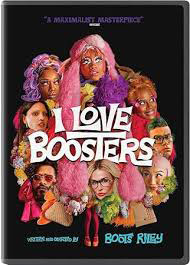
I LOVE I Love Boosters. Even more zany than Boots Riley’s first feature, Sorry to Bother You (2018), it is likewise a delightful, surreal excoriation of capitalism and a celebration of the importance of community and worker organizing. That a leftist movie by an avowedly communist Black American has played in popular wide release is a sign of cultural hope.
In fairness, I offer what’s called a spoiler warning: I will be divulging events and developments in the plot. But given not only the visual richness of the film but also its wealth of jokes, devices, asides, twists, tricks and details, it’s hard to think any description could actually “spoil” it for a viewer. And as Eileen Jones says in Jacobin, “Everybody should see it at least twice.”
The boosters in question are organized shoplifters; as described in the 2006 song by Riley’s musical group The Coup, “A booster is a person who jacks from the retail / And sells it in the hood for dirt-cheap resale.”
The topic is timely, given that the U.S. House in spring passed the Combating Organized Retail Crime Act (CORCA), which would use the excuse of cracking down on shoplifting to significantly expand domestic surveillance and policing by the Department of Homeland Security.
The Bill cites The National Retail Federation, although in 2023 the trade group retracted its estimate that “organized retail theft” was responsible for half of the nearly $100 billion worth of merchandise that went missing in 2021, acknowledging it was more like five percent of that figure.
Like the song, the film makes clear that boosters work hard and provide appreciated resources to poor communities, and both song and film place their work in context of global capitalist exploitation.
Romp of the Velvet Gang
Corvette (Keke Palmer) and her friends Sade (Naomi Ackie) and Mariah (Taylour Paige) are the Velvet Gang, who specialize in boosting clothing designed by Christie Smith (Demi Moore). Corvette, a designer herself, admires Smith’s styles until she finds some of them were stolen from Corvette’s own social media posts.
Smith spouts claims about her clothing being world-changing, but her skewed perspective is indicated by the slant of her office building, tilted at a 45-degree angle, an exaggeration of the slant of the luxury Millennium Tower, a real architectural disaster in San Francisco that by 2022 had tilted 28 inches as measured from the roof.
Similarly wacky devices abound, most notably the portable teleporter that connects the factory workers in China with the retail workers in California, and also has a “deconstruct” setting that sends things and people back to a prior state, as well as a “situational accelerator” setting that “heightens the contradictions.”
The Velvet Gang get jobs in one of Smith’s Metro Designers stores in order to clean out the inventory, and there they meet Violette (Eiza González) who is trying to organize her fellow workers around their labor demands.
They also encounter Jianhu (Poppy Liu), a factory worker from China, who beats them to the theft with the stolen transporter, as part of a plan to hold the clothing hostage on behalf of the factory workers’ demands.
These diverse groups — workers and boosters, Chinese and American — must come to see themselves as on the same side in their struggles.
The colors are eye-poppingly bright, buoyant, bedazzling, candy-colored clothing and coordinated costumes. The film has been described as surreal, absurdist, camp, screwball, cartoonish, looney-tunes, wacky and zany.
Riley’s films are surreal, exaggerating and often literalizing the experiences they represent. Sorry to Bother You, for instance, invokes ideas of worker dehumanization and tropes of “working like a horse” when it turns out workers are literally being transformed into horse-people (“equisapiens”). The miniseries I’m a Virgo (2023) literalizes the sense of not fitting in when it takes as its protagonist a 13-foot-tall teenager.
In I Love Boosters, Corvette is followed by a giant, rolling ball of bills and paperwork that towers over nearby buildings and threatens to crush her. Employee lunch breaks are so short that workers leave for them from racers’ starting blocks.
What’s “Zany”
Many reviewers have noted how “zany” the film is; indeed some have found it a bit exhausting. It’s a “zany love letter to theft” (Salon), a “zany heist comedy” (Vice), with “zany costumes” and a “zany vision” (Reverse Shot), zany, zany, zany (The New Yorker, People, The Film Stage). But, perhaps as a result, some also find it “tiring” (Jacobin), “overwhelm[ing],” (The Boston Globe), “too busy” (AP News).
The “zany” is one of the 21st century’s key terms “for grasping how aesthetic experience has been transformed by the hypercommodified, information-saturated, performance-driven conditions of late capitalism,” argues Sianne Ngai in her book Our Aesthetic Categories: Zany, Cute, Interesting (2012).
In Ngai’s account, the “cute” corresponds to consumption (“so adorable I could eat you up”), the “interesting” to circulation (share now, look at this) and the “zany” to production (think of Chaplin in Modern Times or Lucy Ricardo on the candy factory conveyor belt).
Although Ngai traces the zany to the 16th century commedia dell-arte figure of the zanni, an itinerant servant forced by crises to migrate in search of temporary work, she finds that the post-Fordist zany highlights the “conditions that have increasingly produced capitalism’s ideal worker as already described by Marx: the perpetual temp, extra, or odd-jobber.”
The contemporary aesthetic category of the zany is about the “intersection between cultural and occupational performance, acting and service, playing and laboring” and reveals “something strained, desperate, and precarious”: “Zany performers are constantly in motion and in flight from precarious situations.”
Thus zany characters perform multiple roles, blur lines between labor and leisure, and are always potentially endangered.
In I Love Boosters, the opening sequence blurs play and work: we see Corvette dancing in a nightclub before she brings a man home not for sex but in order to sell him a pair of shoes. In the course of the film, she performs the roles of partier, shopper, barista manager and retail employee, but also acts as designer and thief and seller.
The frenetic, dangerous aspects of the zany ramp up in the later part of I Love Boosters, with a mad chase scene up and down the hills of San Francisco, with a van driving up a shopping mall escalator and people jumping from California to China and back (with the aid of the teleporter).
Shot with scale models and stop-motion animation, the janky visuals make the zaniness all the more jarring and discomforting.
Beyond Zany Amusement
Yet Riley’s film looks beyond this zany expression of the exhausting demands of capitalism, its strenuous hilarity. In the last movement of the film, the zaniness becomes increasingly frenetic, until the situational accelerator transforms crowds of spectators into political actors, with union signs appearing in everyone’s hands.
Labor actions spring up around the globe, with worldwide strikes and even, we’re told, some restructuring of the economy.
A glimpse beyond capitalism means a move beyond the arduous amusement of the zany. As Riley has noted, while the plot is about boosters, one of the film’s deeper themes is loneliness engendered by life under late capitalism.
Several characters have been seduced by a “Friends Being Friendly” pyramid scheme that promises community as well as wealth, suggesting the ways that platform capitalism tries to sell us connection to others.
Corvette is tempted by an attractive demon (LaKeith Stanfield) who says he sees and shares her loneliness, but who has a bad habit of sucking out people’s souls through their genitals. While several reviewers have seen this character as digressive or irrelevant, it speaks clearly to the question of how Corvette will resolve her sense of loneliness.
Pinky Ring Guy (as the demon is also known) is filmed with a slowly rippling effect, the antithesis of the zaniness of much of the rest of the film. He seems to offer an escape from loneliness into heterosexual bonding.
But Corvette chooses instead the community of her friends and fellow workers. The illusion of retreat into an impoverished private sphere (with no oral sex, since it’s how he sucks out a partner’s soul) does not resolve the pains of capitalism.
The strenuous comedy of the last act gives way in the denouement, then, to the rousing promise of goal-directed movement. The precarity that creates separation from the zany character and keeps friends from truly seeing one another can be overcome.
In real life, of course, the situation is accelerating without the use of a fanciful device, the contradictions between labor and capital heightening, as diverse groups increasingly recognize our common interest and learn to take collective action.
November-December 2026, ATC 245