
Against the Current, No. 240, January/February 2026

-
Racial Injustice Inferno
— The Editors -
Vanity Vandalism: Trump's Versailles on the Potomac
— Michael Steven Smith -
Homelessness Safety Net in Tatters
— Louise Gooden -
After the 2024 Elections: Where Do We Go from Here?
— Paul Ortiz -
A New McCarthyism?
— Kristian Williams -
Retrieving History: Ukrainian People's Republic
— Vladyslav Starodubtsev -
Chile: Rise of the Far Right
— Oscar Mendoza -
A Dissident's Dilemma: Albert Maltz's Rediscovered Novel
— Patrick Chura - The Black Struggle
-
Taxation without Representation
— Malik Miah -
Freedom Train and Worker Solidarity
— Paul Prescod -
An American Betrayal of Trust
— Joel Wendland-Liu -
Sinners: The Power of Connections
— Frann Michel -
Trump's Latest Racist Tirade
— Malik Miah - Vietnam
-
An Antiwar GI's Story
— an interview with Howard Petrick -
Researching a Movement
— an interview with Martin J. Murray - Reviews
-
On Ernest Mandel's Contributions
— Paul Le Blanc -
Jewish Anti-Zionism in Perspective
— Lex Eisenberg -
Parchman Life Unfiltered
— Marlaina Leppert-Miller - Parchman Life Unfiltered
-
Serious History in Comix
— Hank Kennedy - In Memoriam
-
Patrick Michael Quinn 1942-2025
— Robert Bartlett
Lex Eisenberg
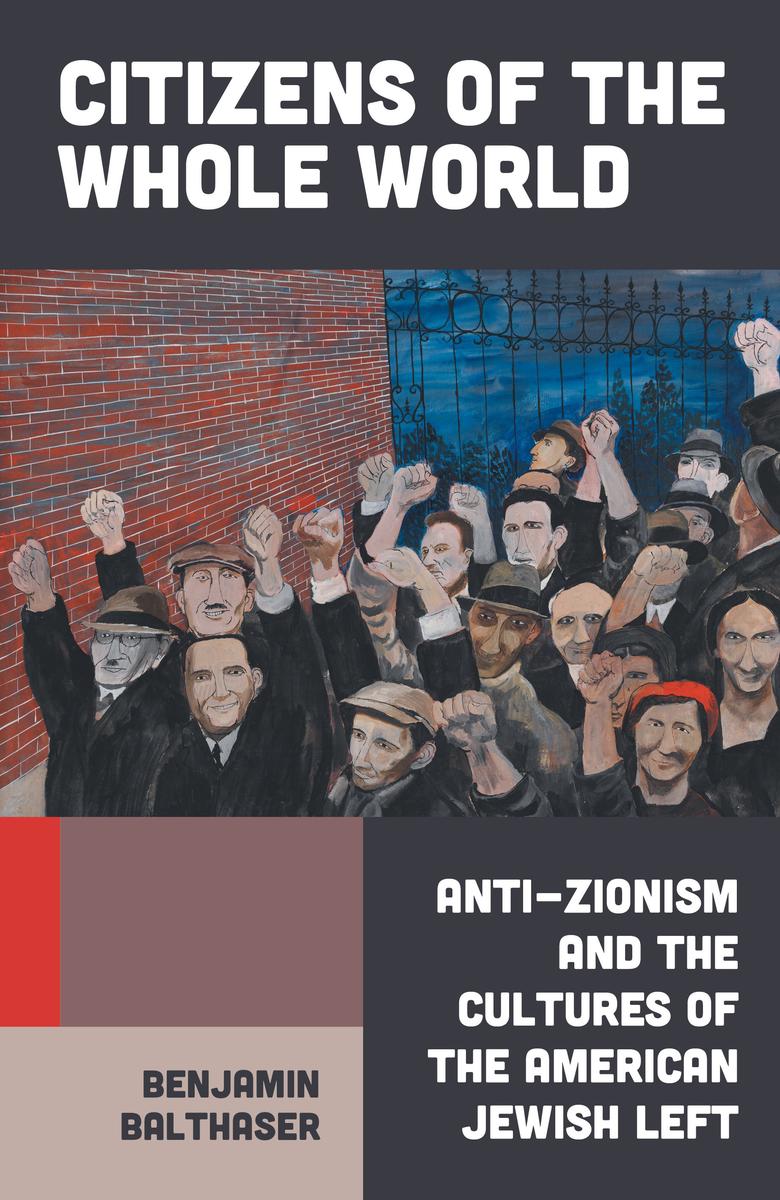
Citizens of the Whole World:
Anti-Zionism and the Cultures of the American Jewish Left
By Benjamin Balthaser
Verso Books, 2025, 320 pages, $29.95 hardcover.
IN THE DAYS leading up to the 2025 New York City mayoral election, a group calling itself “The Jewish Majority” published an open letter decrying the “political normalization” of anti-Zionism in the United States.
The letter, which gained the signatures of over 1,100 rabbis and cantors, took aim at mayoral candidate and democratic socialist Zohran Mamdani, insisting that Mamdani poses a threat to the safety and dignity of Jewish New Yorkers because Zionism is an inextricable aspect of Jewish identity.
What struck me about the letter beyond its blatantly false claims, Islamophobic undertones, and weaponization of Jewish fear to advance bourgeois interests (more on this later) is the name “The Jewish Majority.” Implicitly targeted here, of course, are Jewish anti-Zionists.
Organized in groups like Jews for Economic and Racial Justice (JFREJ), the 501(c)4 arm of Jewish Voice for Peace (JVP), and Democratic Socialists of America (DSA), “Jews for Zohran” comprised a sizable and organized base of the coalition that led Mamdani’s historic campaign to victory.
This political mobilization of Jewish leftists is consistent with, and in ways an outgrowth of, the past two years of organized Jewish uprising against the ongoing genocide in Gaza, in which unprecedented numbers of anti-Zionist Jews have organized direct actions and campaigns in solidarity with Palestinians — often visibility and explicitly as Jews.
Their goal is to destabilize the political, economic, and cultural pillars of the U.S.-Israel alliance, including the link between Zionism and Jewishness that “The Jewish Majority” attempts to affirm in their grotesque letter.
The letter exemplifies a well-worn tactic of mainstream Jewish institutions: to marginalize anti-Zionist Jews as fringe and self-hating deviants, disconnected from Jewish peoplehood, culture and values.
Days after thousands of JVP activists in November 2023 mobilized to sit in at the Capitol rotunda to demand a ceasefire, editor-in-chief of the Jerusalem Post penned an op-ed titled “No Longer Part of Us.”
The author claims that “Pro-Hamas Jews” have forsaken their Jewishness and calls upon readers “to view them as lost to our people and treat them as such” (I use this example in part because the article’s feature photo is yours truly wearing a “Free Palestine” kippah, making the ostracization that much more personal).
More recently Jason Greenblatt, CEO of the Anti-Defamation League (ADL) can be found comparing the proportion of anti-Zionist Jews to Black Republicans and falsely claiming that “95%” of Jews are Zionist, despite data disputing and complicating that figure (including 61% of U.S. Jews who say that Israel has committed war crimes against Palestine, and 39% who say Israel is committing genocide).
Though the ADL was initially established to counter KKK-inspired anti-Jewish violence, it now apologizes for billionaires giving Nazi salutes and declares anti-Zionism a form of antisemitism.
The Anti-Zionist Jewish Left
Beyond reinforcing a false (and antisemitic) idea that all (real) Jews are a political monolith, these examples represent efforts to naturalize the dominance of Zionist politics as a defining and transhistorical value of Jewish life, rather than a recent political construction.
As scholar Benjamin Balthaser’s book Citizens of the Whole World: Anti-Zionism and the Cultures of the American Jewish Left makes clear, however, “there has always been an anti-Zionist Jewish left; indeed, it is the emergence of a Zionist consensus post-1967 that has been the historical oddity.”
While the fact that antizionism on the Jewish left is not new feels intuitively true for many Jewish leftists today, Balthaser — a millennial member of the JVP Chicago chapter and Jewish Solidarity Caucus of the DSA, which formed in support of DSA’s Boycott, Divestment and Sanctions resolution in 2017 — traces a lineage from present to past anti-Zionist organizing, clarifying and contextualizing the shoulders on which we stand.
In doing so, Balthaser addresses what he calls an “absent-presence” of lived memory of the Jewish left, which “remains contradictory and refracted, both forgotten and mythologized at the same time…citational rather than deeply historical.” Balthaser argues that this erasure is intentional, not just because the Red Scare wiped out both the Communist Party and our history of the old left, but also because Jewish history is “told by the bourgeoisie for the bourgeoisie.”
Such whitewashed and assimilationist historicization marginalizes the cultural force of the Jewish left and up-sells the import of mainstream Jewish organizations (think: rabbis on the upper east side of Manhattan undemocratically asserting themselves as “The Jewish Majority”), contradicting the lived reality of many leftist Jews who see our activism “less as a break with earlier generations but a continuation of it in a new form.”
Personally, I’ve yearned to understand this lineage with greater nuance, as Jewish leftists’ frequent yet often shallow invocations of the Jewish Labor Bund (the secular Jewish socialist party formed in the Russian Empire and active between 1897 and 1920, which opposed Zionism and advocated cultural autonomy for Jews within a multi-national state) gesture towards, but do not fully ground, inform or delineate the roots of our organizing in the United States.
Balthaser asks critical questions for contemporary organizers: how did we get here? And what are the continuities and discontinuities between us and prior generations?
Four Historical Moments
Rather than telling a definitive history, Balthaser examines four moments of Jewish left-wing upsurge: the old left, the new left, the “identitarian” left of the 1970s, and finally the new socialist and anti-racist movements of the Trump era.
In doing so, he situates contemporary Jewish leftists (who today show out for Mamdani and Palestine alike) in a cultural lineage of 20th century radicalism where the “(re)emergence of a distinctively Jewish left that has held a remarkably consistent critique of Zionism.” Balthaser’s research is based on an obvious yet revealing premise: To understand the Jewish left, we must examine the longer history of the American radical left, of which Jews have been an active and influential part.
Socialism, the Jewish Promise Land
Examining Jewish lefts as they existed in formations like the Communist Party USA (CPUSA), Students for a Democratic Society (SDS), the Socialist Workers Party (SWP), Jewish socialist collectives like the Chutzpah Collective and Brooklyn Bridge Collective, and the New Jewish Agenda (a predecessor of JVP), Balthaser finds that for far longer than there has been a U.S. Jewish pro-Israel “consensus,” there have been “more continuities than breaks on the question of Zionism and solidarity with other oppressed ethnic groups and religious minorities.”
Invoking Gramsci, Balthaser argues that Jewish anti-Zionism emerged organically from the commitments of socialist U.S. Jews, and was seen as common sense in the fight against fascism and imperialism. Balthaser notes that while many on the U.S. Jewish left were temporarily “converted” to Zionism, this was due to the Soviet Union’s support for Partition (the 1947 United Nations resolution), which he says was short-lived for both the Soviet Union and the Jewish left.*
The book’s title is illustrative of Balthaser’s core findings, as well as his esoteric knowledge of the unsung histories and sub-cultures of the Jewish left. Citizens of the Whole World references a line from an unpublished novel by Robert Gessner, a Jewish writer and filmmaker from the 1930s whose work made connections between Indigenous genocide on turtle island, Zionist settler colonialism, and fascism. In a fictional dialogue between U.S. Jewish socialists and Jewish members of the Irgun (a Zionist paramilitary organization), the former implore: “You’re an alien in Israel because you are a citizen of the whole damn stupid world.” Following the Jewish socialists’ common sense about Zionism, Jewish identity built around the establishment of a Jewish state in Palestine is irreconcilable with his values of internationalism, multiethnic democracy, and a diasporic Jewish ethic of relationality and resistance.
Quoting the scholar Yuri Slezkine, Balthaser discusses how of the three Jewish “promised lands” in the 20th century — citizenship in the United States (assimilation), emigration to Israel (Zionism), and the Bolshevik revolution (socialism) — socialism was the most popular answer to antisemitism between the world wars.
Balthaser reminds us that throughout the 1930s, an estimated half the CPUSA members were Jewish, amounting to possibly hundreds of thousands, or 5-10% of U.S. Jews over the decade (recall that Eugene Debs got 40% of the Jewish vote in 1920, and 4% in the general population). This well exceeded the ranks of Jews who participated in liberal organizations like American Jewish Committee (AJC), American Council for Judaism (ACJ), and the ADL.
Though the Bund never had a large foothold in the United States, Balthaser describes how American Jewish leftists constructed an “ethnic particularism” that echoed some of the Bund’s cultural politics, whereby their radicalism became a way to separate themselves from the larger bourgeois, Anglo-Saxon, Christian-dominated U.S. culture.
Until partition in 1947, the commonsense among Jewish members of the CPUSA and other U.S. radical left groups viewed Zionism as a form of imperialism aligned with the bourgeois interests of the Jewish ruling class, which turned working-class Jews into accomplices in colonial oppression and exploitation.
Here Balthaser draws extensively on the writing of Alexander Bittelmen, an influential Jewish theorist and editor for Communist Party, whose anti-imperialist framework led him to adopt the position of the Palestine Communist Party. (“Palestine: What is the Solution?,” 1946)
Summarizing, Balthaser says that Bittelman and others felt that “if Jews had any role to play in Palestine, it would be to free Palestinians from colonial rule, no more or less.”
For them, the alternative to the undemocratic forces of both “reactionary nationalism” (Zionism) and “assimilationism” were “progressive Jewish values” — referring to secular culture of social democracy, anti-racism and cultural diversity, expressed through Jewish tradition.
Red Scare and its Consequences
While prior scholars document how Ashkenazi and other Euro-descended jews “became white folks” during the 20th century by ascending into the middle class, Balthaser’s work gives texture to this transition by pointing to the Red Scare as another major cause.
For thousands of Jews on the communist and socialist left, the 1940s and ’50s were defined not by postwar abundance and consensus, but rather the emergence of a postwar fascism. From the late 1940s to mid-’50s, over half of Americans associated Jews with communist espionage; two-thirds of those questioned in the McCarthy hearings were Jewish (Jews were less than 2% of the population at the time); and the only two people executed on federal espionage charges, the Rosenbergs, were Jewish.
Even as the Red Scare mobilized antisemitic tropes and actions to target Jews, liberal Jewish organizations like the ADL participated in the purge. Quoting April Rosenblum, Balthaser says that for Jews on the left, assimilation was “an offer they could not refuse.”
The legacy of the Red Scare has consequences for the Jewish consensus on Zionism, as large Jewish institutions shifted their communication strategies, funding, and political priorities toward supporting Israel by the 1967 Arab-Israeli war, and Zionism replaced the Jewish left as a more acceptable means for expressing Jewish identity.
Balthaser describes how most historiography positions Israel as the new center of American Jewish life in this era, as Jews entered into mainstream whiteness, and the Black-Jewish interracial alliance (there was greater support among Jews for the civil rights movement than for Zionism during the 1950s) devolved as Jews felt threatened by the Black Power movement’s critiques both of Zionism and Jewish liberalism.
Ironically, this new Jewish nationalism styled itself after the Black nationalist movement, as Jews adopted more expressive group identity through Jewish day schools, a reformation of Jewish culture, and celebration of Jewish looks.
Yet this historical narrative overlooks Jews on the 1960s New Left, including disproportionate Jewish membership in groups like SDS, the SWP, and the Yippies, who rejected both whiteness and multicultural liberalism in favor of an anti-imperialist politics anchored in the Black liberation movement’s racial and political analysis of the U.S. invasion of Vietnam.
As former SDS and later Weather Underground member Mark Rudd observed, SDS was “a Jewish fraternity” (roughly half Jewish at its outset), that also referred to itself as the “northern arm of SNCC” and continued to back it after it transformed to a Black Power organization. Balthaser unpacks a series of articles, pamphlets and resolutions put out by SDS and SWP that were critical of Zionism and the 1967 war, most of which were debated and authored by Jews.
Though many Jews on the New Left did not openly identify as Jewish (with many favoring identities as anti-racist whites) Balthaser finds that their Jewishness was nonetheless “integral [to] their outlook, subjectivity, and radicalness.”
Both Inside and Outside
Contrary to a historical assumption that the Holocaust was a turning point that made Jews more conservative and assimilationist, Balthaser describes how activists’ memories of the Holocaust — and the desire not to act like “good Germans” — motivated their activism against the Vietnam War and their leftist politics more generally.
As many came from newly assimilated families, revolutionary activism was simultaneously a rejection of their middle-class upbringing, and a (re)discovery of Jewish lineage and values. Or as Abbie Hoffman satirized, they opted to break with the Jewish tradition of “going for money” (choosing gelt and assimilation), for the (other) Jewish tradition of “going for broke” (radicalism and rebellion).
Hence, “Jews on the New Left experienced themselves both as Jewish and not Jewish, white and other, inside and outside the world they lived in.”
So how did we get to the prominence of Jewish identity politics of today, exemplified in groups like JVP and the “Jews for Zohran” campaign? While Balthaser doesn’t have a definitive answer to this, he discusses the work of three organizations — the Chutzpah collective, the Brooklyn Bridge Collective (BBC), and the Jewish Radical Community.
All of these remained somewhat marginal throughout the 1970s and ’80s, but practiced new forms of non-Zionist and anti-fascist organizing explicitly as Jews, which would directly inform Jewish formations that exist in the present.
Balthasar argues that Chutzpah and BBC can be thought of as direct predecessors to JVP in how they broke down the divide between Jewish religious and secular political traditions, and invoked a “Neo-bundist” ethic that stressed Jewish organizational autonomy as a means by which Jews could join larger communities of struggle.
Identity and Internationalism
Throughout, Balthuser’s work traces a dialogic relationship between Jewish identity formation and Jewish internationalism in diaspora. Today it’s common for Jewish leftists to qualify their identity and politics as “disaporic”— you can even buy a JFREJ t-shirt that reads “diasporist” on the front, a core organizing principle of JFREJ, which evolved from the politics and writing of Melanie Kaye/Kantrowitz, the lesbian feminist poet, activist, and founding Executive Director.
As she wrote: “Diasporism takes root in the Jewish Socialist Labor Bund’s principle of doikayt — hereness — the right to be, and to fight for justice, wherever we are…Where Zionism says go home, Diasporism says we make home where we are…Diasporism depends not on dominance but on balance, perpetual back and forth, home and away, community and outside.”
Similarly, Judith Butler asks us to consider dispersion not just as a geographic fact of Jewish survival, but as an “ethical relation” whereby cohabitation with the other — and through that relation having one’s self-conception repeatedly interrupted, de-stabilized, and reformed — makes one other to one-self. They argue that this “ineradicable alterity” is not only central to what it means to be Jewish, but also fundamental to conceptions of equality and justice.
This review is lengthy in part because this book is a bubbling stock pot of historical and cultural nuance that’s impossible to convey concisely — but also because it’s a hard read. Partly that’s because, as Balthaser names, it is not a history but “a cultural studies project and relies as much on literature, feelings, and affect as it does on causal narratives.”
I haven’t even touched upon Balthaser’s textured cultural analyses — which draws upon diasporist fiction, poetry, and drama from authors including Mike Gold, Tony Kushner, Philip Roth, Aurora Morales Levins, Martin Espada (and many others). Weaving these cultural threads together, Balthaser offers a tapestry of disaporic lineage deserving of reverence and regard by the Jewish left.
If you’ve made it this far, you’re likely wondering whether you should read the book yourself. Fair warning, although the language isn’t exceptionally esoteric (I can read 10 pages of this book in the time I can read a single page by Judith Butler), I found myself losing Balthaser’s main points through the weeds of his analysis.
To go with the soup analogy, Balthaser’s cultural deep dives left me feeling full but unsure about exactly what I had eaten, and unable to name the ingredients or recall the recipe when it’s my time to cook. Had I not been asked to write this book review (we write in order to understand) I might have left this book with a foggy idea of the main takeaways, or put it down after his 50+ page introduction (as did the rest of my book club of Jewish leftists).
I’m glad that this book exists, and I’m glad Balthaser is translating his work into essays and podcasts that are more digestible for organizers who are busy fighting fascism.
Jewishness Expressed as Solidarity
For now, “The Jewish Majority” is still liberal and Zionist: according to exit polls, 63% of New York City Jews cast their ballots for Cuomo. But this manufactured consensus — attributable in part to a terrain of class struggle that squandered the Jewish left at its zenith — is in peril.
As the Jewish institutional elite has grown callused by the contradictions of a genocidal politics that masquerades as Jewish safety, in its cracks grows a generation of Jews finding political home in anti-Zionism, socialism, and increasingly, both (a July poll showed Mamdani leading with 67% support among Jews aged 18-44).
Here we encounter, in our elder comrades, in a Jewishness expressed as solidarity, and in Balthaser’s work — a tradition laid buried in plain sight. We know, as our ancestors did, that a Jewish politics of liberation must be grounded not only in freedom for Palestinians, but all working-class and oppressed people.
Yet, to reinvoke Butler: “Equality, justice, cohabitation, and the critique of state violence can only remain Jewish values if they are not exclusively Jewish values.” We don’t need to wait to be “The Jewish Majority” to win; we need to build a multiracial, democratic majority through solidarity and class struggle.
* Editors’ note: The record of the left’s efforts to grapple with the Palestine partition and ensuing tragedy, including tangled shifts in policy by U.S. communists and the Soviet Union, is a huge subject in its own right. Balthasar references a contribution by Dorothy Zellner, a lifelong activist, an historical figure in SNCC and outspoken today in the solidarity movement for Palestine, which appeared in the May 12, 2021 issue of Jewish Currents, “What We Did: How the Jewish Communist Left Failed the Palestinian Cause.”
January-February 2026, ATC 240