
Against the Current, No. 240, January/February 2026

-
Racial Injustice Inferno
— The Editors -
Vanity Vandalism: Trump's Versailles on the Potomac
— Michael Steven Smith -
Homelessness Safety Net in Tatters
— Louise Gooden -
After the 2024 Elections: Where Do We Go from Here?
— Paul Ortiz -
A New McCarthyism?
— Kristian Williams -
Retrieving History: Ukrainian People's Republic
— Vladyslav Starodubtsev -
Chile: Rise of the Far Right
— Oscar Mendoza -
A Dissident's Dilemma: Albert Maltz's Rediscovered Novel
— Patrick Chura - The Black Struggle
-
Taxation without Representation
— Malik Miah -
Freedom Train and Worker Solidarity
— Paul Prescod -
An American Betrayal of Trust
— Joel Wendland-Liu -
Sinners: The Power of Connections
— Frann Michel -
Trump's Latest Racist Tirade
— Malik Miah - Vietnam
-
An Antiwar GI's Story
— an interview with Howard Petrick -
Researching a Movement
— an interview with Martin J. Murray - Reviews
-
On Ernest Mandel's Contributions
— Paul Le Blanc -
Jewish Anti-Zionism in Perspective
— Lex Eisenberg -
Parchman Life Unfiltered
— Marlaina Leppert-Miller - Parchman Life Unfiltered
-
Serious History in Comix
— Hank Kennedy - In Memoriam
-
Patrick Michael Quinn 1942-2025
— Robert Bartlett
Paul Prescod
Freedom Train
Black Politics and the Story of Interracial Labor Solidarity
By Cedric De Leon
University of California Press, 2025, 352 pages, $29.95 paperback.
ONE HUNDRED YEARS ago on August 25, 1925 Black Pullman car porters streamed into the Elks Hall in Harlem. They gathered to hear the socialist A. Philip Randolph speak about the need for porters to form a union.
This meeting wasn’t just the beginning of a union drive; it was the start of a long battle to organize Black workers into unions and root discrimination out of the existing labor movement. It’s a fitting time to look back on the history of interracial unionism and how Black workers fought so hard to build it.
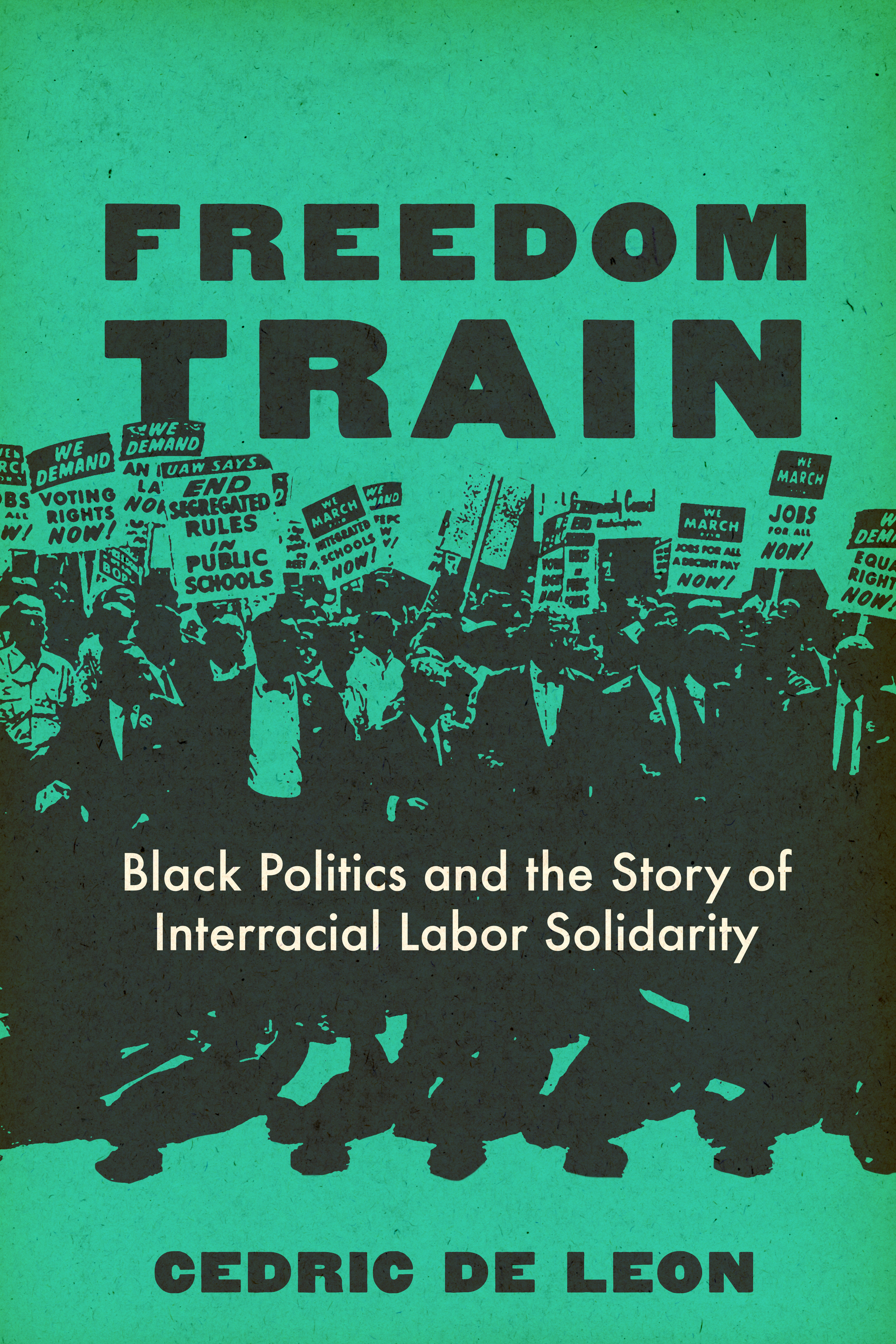
Cedric De Leon’s new book Freedom Train: Black Politics and the Story of Interracial Labor Solidarity traces this story from the pivotal years of 1917 to 1968. The book is a welcome contribution to the scholarly literature on the subject, and contains a succinct account of important but often overlooked organizational iterations within the Black working class.
However, De Leon’s overarching case — that labor history has on the whole marginalized the role of Black activists and overly valorized white activists — feels like an overstated strawman argument.
Though Black workers had been involved with early labor movement efforts like the Knights of Labor, Industrial Workers of the World, and the United Mine Workers of America, the book begins its narrative with the dynamic duo of A. Philip Randolph and Cyril Briggs in 1917.
These two figures began their partnership around The Messenger magazine, which espoused the virtues of socialism for a Black audience. Eventually they would part ways to represent different visions and organizational expressions for the Black working class.
Randolph’s monumental 12-year struggle to organize the Brotherhood of Sleeping Car Porters is more well-known and written about. But the African Blood Brotherhood (ABB), which Briggs devoted his energies to in the 1920s, is less familiar to most readers.
Springing from Briggs’ newspaper The Crusader, the organization combined a mish mash of ideologies that would continue to be important in Black political developments throughout the 20th century.
ABB and Labor
The ABB’s platform included the ending of Jim Crow segregation and the right to vote in the south. In this way it overlapped with more mainstream civil rights organizations like the NAACP and Urban League. But it diverged in that it called for armed resistance against lynchings and emphasized the fight against imperialism. They also demanded unions end discrimination so that Black workers could join.
Briggs was inspired by the Irish nationalist movement, which can be partly seen in his aspirations for the ABB. The organization was set up to be a secret paramilitary group with a Supreme Council, with Briggs serving as “Paramount Chief.”
The Tulsa Riots of 1921, where Black neighborhoods in the Greenwood district of Tulsa were burned down and hundreds murdered, brought the ABB to prominence for a brief period. The Tulsa ABB chapter was blamed for starting the riot because members, many of whom were World War I veterans, had taken up arms in self-defense.
While the charge of starting the riot was false, it served to give the organization a boost in notoriety. A few weeks later over 2,000 people attended an ABB rally in Harlem.
Over the next year the organization developed a close relationship with the Communist Party, so much so that the party thought of them as an auxiliary. While the ABB sought to become a mass movement, they never recruited more than 3,500 members and in practice acted more as a propaganda group.
De Leon characterizes the ABB as representing the left-wing of “Black labor” at the time, but this is somewhat problematic. It’s not clear how much involvement there was from actual Black workers, unlike the Brotherhood of Sleeping Car Porters (BSCP). which clearly had a base of support among not only Pullman porters but also the broader Black working class.
The book covers ABB’s involvement in an early coalitional effort between Black civil rights organizations which would prefigure future similar initiatives.
A “United Front Conference” effort was initiated after conservatives in Congress defeated anti-lynching legislation. The conference was held on March 23, 1923 to discuss where the movement for Black equality should go next.
The gathering was significant for the breadth of civil rights organizations involved: the ABB, NAACP, Friends of Negro Freedom (led by A. Philip Randolph), National Equal Rights League, National Race Congress, and the International Uplift League. A follow-up conference was called, but internal disputes derailed the effort.
There was an attempt to marginalize the ABB by more moderate figures like Howard University dean Kelly Miller, and trade unionists like Randolph worried about sectarian infiltration of the Brotherhood. These kinds of factional divisions are routinely explored throughout the book.
The sections covering the 1930s and 1940s, a period rich in labor and civil rights activity, are among the more interesting ones. Central in this story is the National Negro Congress, a true united front organization that set as a priority the organizing of industries where Black workers were most concentrated.
John P. Davis, who started the National Industrial League to keep track of discrimination in the early days of the New Deal, was able to broker connections with the American Federation of Labor (AFL) and stimulate organizing in the steel and auto industries.
The success of the NNC depended on its ability to unite a wide spectrum of Black organizations around a “minimum program” of action they all could agree on. But it became harder to hold this coalition together with a rapidly changing domestic and international political situation.
Communist Party members constituted a significant core of NNC activists. Given the 1939 Stalin-Hitler pact, by the time of the 1940 convection, the party was fiercely opposed to Franklin D. Roosevelt and any involvement in a war against Nazi Germany. These issues overtook the convention and Randolph felt he had to resign as head of the organization.
Randolph’s March on Washington Movement to end employment discrimination in defense production industries is also covered. This movement was centered around the audacious threat to march 100,000 Black workers on Washington, DC.
Though receiving tepid support from the NAACP, this effort was really driven by the Brotherhood of Sleeping Car Porters. While official Black civil rights organizations remained aloof, the movement caught fire among the masses of Black working people and other elements of Black civil society.
The NNC, by this time thoroughly dominated by the CP, was not supportive but dared not be too openly critical because it “would be bound to lead to our isolating ourselves from the masses of the people,” according to John P. Davis.
Cold War Politics
One of the many tragedies of the Cold War was how it divided elements of the Black left that mostly agreed on domestic issues. It is described in some detail how this played out among Black labor activists in the late 1940s and 1950s.
The Negro Labor Committee was formed by Randolph and Black socialist Frank Crosswaith as a direct counter to the CP-influenced National Negro Labor Council (NNLC). Both organizations sought to end discrimination in employment and within the trade unions.
De Leon provides helpful examples of the gains the NNLC was able to win during this period. Their first national campaign sought to win clerical positions for Black women at the Sears Roebuck Company, which they won by 1953. Due to their pressure Brooklyn Union Gas Company hired Black meter readers, and General Electric in Louisville began to hire Black workers. Coleman Young, who would eventually go on to become the first Black mayor of Detroit, got his start as a UAW and NNLC activist during this period.
Despite these successes, the NNLC was largely marginalized from the mainstream of the labor movement. Randolph continued relentlessly at AFL-CIO conventions to push for unions to end discriminatory practices.
The book includes colorful accounts of the clashes between Randolph and AFL-CIO president George Meany. For example, at the 1959 convention Randolph brought forward a resolution to expel two railroad brotherhoods unless they removed color bars from their constitutions, to which Meany replied, “Who appointed you as the guardian of the Negro members in America?”
The fallout from this incident led to the formation of yet another Black labor organization, the Negro American Labor Council (NALC). Here too the old battles were reignited, but not to the point of collapse. Women mobilized to attain more leadership positions in the group.
Again the focus was on battling discrimination within the house of labor; their lobbying led John F. Kennedy to sign an affirmative action Executive Order on March 6, 1961. Later the same year the AFL-CIO Executive Council passed a civil rights resolution.
Division over anti-communism arose again, as some claimed that NALC chapters were being taken over by the CP. When NALC leader Lola Belle Homes revealed she was working with the FBI to identify communists, Randolph removed her from her leadership position.
But the best way to address internal division is productive outward facing work, and De Leon devotes significant space to describing how the NALC was instrumental in the program and logistics of the 1963 March on Washington for Jobs and Freedom.
Though the AFL-CIO did not formally endorse the march, critical institutional support was garnered through NALC connections. First conceived as exclusively a march for jobs, the demands of a federal public works and training program, a federal Fair Employment Practices Act, and a broadening of the Fair Labor Standards Act bear the imprint of Black labor activists.
In the summer of 1964 NALC called for a one-day national general strike if the Senate blocked civil rights legislation. One can’t help but think this was at least part of the reason that the Senate voted to close off debate on civil rights legislation for the first time in history, which led to the passage of the Civil Rights Act later that year.
Black Workers Lead
In the introduction the author asserts that in labor history scholarship, “Black workers typically show up as minor or passive actors in their own history.” He sees the book “challenges scholars and activists to think differently about the cause of interracial labor solidarity, which I define here as a vision of working-class comradeship based on the principles of inclusive membership, representative leadership, and the struggle for economic and racial justice.”
At the end of each chapter De Leon hammers home the same central theses that underpin the book. Chief among them is that Black workers took the lead on interracial unionism while white workers were inconsistent allies.
De Leon goes further and states that it is a mistake to look for interracial solidarity in unions because “Black people in this period were unlikely to be union members.”
However, this critique of labor scholarship doesn’t appear to align with the actual record. A long line of labor historians have paid great attention to the role of Black workers as leaders in building thriving interracial unions.
Roger Horowitz’s “Negro and White, Unite and Fight!”: A Social History of Industrial Unionism in Meatpacking, 1930-90 gives a detailed overview of the efforts Black activists made to turn the United Packinghouse Workers of America into a vibrant anti-racist union. August Meier’s Black Detroit and the Rise of the UAW recounts how Black auto workers broke through Henry Ford’s paternalism and collaborated with civil rights organizations to win a union. Pullman Porters and the Rise of Protest Politics in Black America by Beth Thompkins Bates centers the role of Chicago’s Black working class and community allies. These are but a few examples.
And while in the 1920s it is true that Black union membership was dismal, this dramatically changed with the rise of industrial unionism and the Congress of Industrial Organizations in the 1930s. Already by the 1940s Black workers were overrepresented in union membership.
Any study of interracial unionism would have to look at the major existing unions and the role of white workers when warranted. De Leon could have explored further the role of craft unionism in reinforcing the inconsistency of white support for interracial unions, and how the rise in industrial unionism significantly (though of course not fully) improved the situation.
Another key assertion is that “centrist” and “left” factions emerged repeatedly within the various Black labor formations. These factional divisions are skillfully explained in each chapter. However, to repeat that there were different factions and political tendencies is like repeating that water is wet. It doesn’t feel like a particularly poignant scholarly revelation.
Despite these critiques aimed at the overall framing of the book, it is a worthwhile and informative read. De Leon retraces critical Black labor history in an accessible manner.
January-February 2026, ATC 240