Against the Current, No. 240, January/February 2026

-
Racial Injustice Inferno
— The Editors -
Vanity Vandalism: Trump's Versailles on the Potomac
— Michael Steven Smith -
Homelessness Safety Net in Tatters
— Louise Gooden -
After the 2024 Elections: Where Do We Go from Here?
— Paul Ortiz -
A New McCarthyism?
— Kristian Williams -
Retrieving History: Ukrainian People's Republic
— Vladyslav Starodubtsev -
Chile: Rise of the Far Right
— Oscar Mendoza -
A Dissident's Dilemma: Albert Maltz's Rediscovered Novel
— Patrick Chura - The Black Struggle
-
Taxation without Representation
— Malik Miah -
Freedom Train and Worker Solidarity
— Paul Prescod -
An American Betrayal of Trust
— Joel Wendland-Liu -
Sinners: The Power of Connections
— Frann Michel -
Trump's Latest Racist Tirade
— Malik Miah - Vietnam
-
An Antiwar GI's Story
— an interview with Howard Petrick -
Researching a Movement
— an interview with Martin J. Murray - Reviews
-
On Ernest Mandel's Contributions
— Paul Le Blanc -
Jewish Anti-Zionism in Perspective
— Lex Eisenberg -
Parchman Life Unfiltered
— Marlaina Leppert-Miller - Parchman Life Unfiltered
-
Serious History in Comix
— Hank Kennedy - In Memoriam
-
Patrick Michael Quinn 1942-2025
— Robert Bartlett
Paul Ortiz
This article is edited from a talk on the 2024 Presidential Election that Paul Ortiz gave at a roundtable session sponsored by Historians for Peace and Democracy at the American Historical Association annual meeting in New York City on January 4, 2025. Paul Ortiz is a Professor of Labor History at Cornell University and an affiliate faculty member of Cornell’s Latino Studies Program. He joined Cornell in 2024 and previously served as director of the Samuel Proctor Oral History Program and Professor of History at the University of Florida.
DURING THIS CRISIS moment across the country, I see people and groups getting reorganized for the long haul across the country. I have spent the better part of the last two months in intense discussions, workshops and emergency sessions with Latino, African American and labor organizations, especially on the crisis of fascism facing our mutual communities after the election victory of Donald Trump.
In these grounding sessions we often begin with a passage in the epilogue to An African American and Latinx History of the United States where I write:
“Inequality in American life today is not an accident. It is not the result of abstract market forces nor is it the consequence of the now-discredited ‘culture of poverty’ thesis. From the outset, inequality was enforced with the whip, the gun and the United States Constitution.
“If my experiences in the labor movement and a lifetime of studying history has taught me anything it is this: this nation was not built for us. But our ancestors in struggle stubbornly persisted and created social movements based on self-help, solidarity, and mutual aid that have allowed them to make it a much better place than they found it.”
This is why I state in the book:
“Those interested in the origins of democratic traditions in this country must look to Latin America, the Caribbean and Africa as often as they look to Europe. In eras when fascism, eugenics and Apartheid dominated the nations of Europe and the Global North, it was often ideas from the Global South — as well as the immigrants who brought those ideas to the United States — that rejuvenated U.S. political culture.”
Fast forward to now. MAGA is trying to crush the newest generation of small-d democratic ideologies that workers have brought from the Global South. MAGA is a manifestation of the United States’ long capitalist history of repressing and disenfranchising immigrant labor — and in fact, all working-class people.
MAGA’s anti-immigrant racism is directed as much against immigrant ideas of solidarity, empathy and trade unionism as it is against immigrants as workers who arrive here as part of what Juan Gonzalez calls Harvest of Empire.
Like earlier eras of insurgent freedom movements including the Industrial Workers of the World (IWW) and the Congress of Industrial Organizations (CIO), immigrant workers from Latin America and other “underdeveloped” parts of the world are playing pivotal roles in rejuvenating labor and social movements in the United States.(1)
Divide and Undermine
The present conjuncture is marked by capital’s effort to divide and undermine people’s democratic efforts to achieve autonomy and economic security in a volatile global economy. This is why MAGA leaders such as Florida Governor Ron DeSantis have tried to smash educational and political efforts to develop “intersectional” ways of thinking about forms of domination.(2)
Crystallized in his attack on African American Studies, DeSantis’s fear of intersectionality is that an inclusive curriculum that includes Black, Latinx, LGBTQ+, Middle East and gender studies will give people tools to fight forms of oppression that appear separate but in fact are inseparably linked.
This is why I no longer separate struggles for academic freedom, immigrant rights, labor and Palestine solidarity — for starters — from each other. Yes, these struggles have distinctive histories that need to be learned. Yet unless we recognize where forms of oppression and resistance intersect, we will never be able to build the kinds of coalitions needed to rekindle the most revolutionary truth of all: an injury to one is an injury to all.
The question “Where do we go from here?” presumes that we have a bit of a clue where we’ve been, how we got here, and what we can do to get out of the mess we are currently in. So, how did we get here?
After his second electoral triumph, it should be clear that Trump, a man who failed to earn a majority of the votes cast in either the 2016 or 2024 presidential elections, is no aberration in American politics. We cannot depend on the nation’s degraded institutions to defend us from Trump’s excesses, because President Donald Trump is a creature of these institutions.
Despite media and even academic efforts to position him as an outsider, President Trump is the consummate insider of a nation built on racial capitalism. Long have the republic’s presidents been enablers of corporate domination, the military-industrial complex and the desires of billionaires against the will of the people.
Scholars in Native American, African American, Asian American, Latinx and working-class studies have demonstrated beyond any doubt that Donald Trump’s predecessors in the executive branch routinely deployed the state in support of imperialism, the genocide of Native Americans, settler colonialism and its grim sibling, the Slave Power.
These are historical realities that the Trump administration and Republican governors are trying to quash through “Anti-Woke” legislation in order to spread the toxic brew of American innocence, ignorance and exceptionalism that MAGA feeds on to serve the ruling class.
Government of the Banks
W.E.B. Du Bois coined the phrase “The Government of American Banks” to describe US racial imperialism in Latin America and the Caribbean. It pains me when historians without irony invoke John Quincy Adams’ venerable quote “America goes not abroad in search of monsters to destroy,” to deny our legacies of racial imperialism.
As a soldier in U.S. Special Forces in Central America in the mid-1980s, I was sent abroad specifically in search of “monsters” to destroy. The work of my fellow soldiers of empire and our predecessors was instrumental in fomenting generations of coups, poverty, and instability throughout the Americas. The predatory behavior of “The Government of American Banks” produced a political culture that created men like Trump.
When Trump attempted to wipe out the results of the 2020 election and remain in office, he followed a plan of action we have helped implement repeatedly throughout the Global South at the behest of our financial institutions. In Latin America, we refer to what Trump did on January 6, 2021 as an autogolpe, literally, a self-coup.
In 2016, Walden Bello characterized Trump as “The Ultimate Blowback from U.S. Foreign Policy,” and went on to explain, “How the CIA, bad trade deals, and wanton military intervention caused the social crises that gave us the Donald. (Really.)” If we are going to build democracy in the United States, we must get honest. Real quick.
The House for Whom?
The house built for Donald Trump was certainly not built for the republic’s laborers — including the hundreds of workers who allege that Donald Trump refused to pay them for services rendered to him.
As we organize for the long haul, we also need to stop obsessively deferring and referring to the so-called Founding Fathers.(3) I hope that my friend and labor history colleague, Dr. John McKerley, won’t mind me quoting a brilliant social media post he made last year:
“It’s really hard to overstate just how much the foundations of the Anglo-American legal tradition suck for workers. Organizing at the local, state, and national level can — and at times has — improved things in some significant ways, but, at least historically, it’s always been a matter of building a scaffolding onto a foundation that is not meant to support us.”
If one’s hypothesis is that this house was built for Donald Trump’s affluent ancestors rather than for the rest of us, then Gustavus Myer’s History of the Supreme Court (1912) published a century before the court’s Citizens United decision, gives us a vital clue how the house’s “scaffolding” was erected by the fathers. Myers noted:
“Palpably, a dominant class must have some supreme institution through which it can express its consecutive demands and enforce its will, whether that institution be a king, a Parliament, a Congress, a Court, or an army. In the United States, the one all-potent institution automatically responding to these demands and enforcing them has been the Supreme Court of the United States.”(4)
Considering the effusion of books on the origins of ruling-class power in the United States, it is no longer even radical to say that the nation’s institutions including the Supreme Court, the executive branch, and the Senate, were designed to block majority rule.(5) Hence, making it easier to elect a Warren G. Harding, a Calvin Coolidge or a Donald Trump as opposed to a Eugene V. Debs or a Jesse Jackson or Shirley Chisholm.
Sheldon Wolin’s brilliant body of work including Democracy Incorporated: Managed Democracy and the Specter of Inverted Totalitarianism (2008) argued that the Founding Fathers erected a federal constitution full of checks and balances, not primarily between branches of government but instead aimed to defend the prerogatives of the wealthy few against the impoverished many, or “the people out of doors” as they (or we) were then known.
Wolin hearkened back to an earlier tradition of scholarship that highlighted the ruling-class interests who sought to create a federal constitution to preserve and promote their interests. This work included University of Washington political economist J. Allen Smith’s The Spirit of American Government (1907).
Drawing from the debates surrounding the ratification of the Constitution, Smith cited wealthy orators who understood class conflict. According to Smith:
“They recognized very clearly that there was a distinct line of cleavage separating the rich from the poor. They believed with [Alexander] Hamilton that in this respect that ‘all communities divide themselves into the few and the many,’ that the latter will tend to combine for the purpose of obtaining control of the government; and having secured it, will pass laws for their own advantage.
“This they believed, was the chief danger of democracy — a danger so real and imminent that it behooved the few to organize and bring about, if possible, such changes in the government as would ‘protect the minority of the opulent against the majority.’”(6)
The Washington State Legislature threatened in 1908 to abolish the UW’s department of political and social sciences due to Professor Smith’s temerity to directly quote the Founding Fathers on the dangers of democracy. Today, university students who protest their institution’s culpability in Endless War, ethnic cleansing in Gaza or the military industrial complex, face harassment, violence, and expulsion from the very institutions alleged to uphold “intellectual freedom.”
The academy has once again abrogated its responsibility to serve all Americans and to be a force for democracy. We have tragically played a role in ushering in the kind of repression we claim to fear from Trump and his MAGA operatives.
Where Democracy Comes From
Where does the democracy we have come from if not from the nation’s original institutions? Where do we find the wherewithal to survive the current crisis and rebuild a nation where, to paraphrase the great Martinican poet Aime Cesaire, “all are welcome at the Rendezvous of Victory.”
The answer is people power. As the nation observed the bicentennial of the Constitution in 1987, Supreme Court Justice Thurgood Marshall explained the freedoms that African Americans and others enjoyed by observing that “’We the People’ ARE no longer enslaved, but the credit does not belong to the framers. It belongs to those who refused to acquiesce in outdated notions of “liberty,” “justice,” and “equality,” and who strived to better them.”(7)
Mark Twain’s observation that “The golden gleam of the gilded surface hides the cheapness of the metal underneath,” nailed the Gilded Age of Robber Barons. However, it is also an apt portrayal of our own time of Endless War, “Crypto Oligarchy,” and continued privatization of the commons.
As Hugh Jackson observed shortly before the 2024 election, “The crypto industry is corrupt & convoluted, but its survival strategy is simple: Control Congress. And the White House too, if possible.”
In my epilogue essay for the 4th edition of Who Built America: Working People and the Nation’s History, I noted of the 2016 election:
“In retrospect, the ascent of Donald J. Trump to the White House was not surprising. Trump’s political opposition was disorganized while Trump’s right-wing supporters were extremely well funded and well organized. Politics had become a spectator sport for too many supporters of the Democratic Party.
“Organizations that had once emphasized direct action to achieve gains increasingly looked to the Supreme Court or media campaigns, social and traditional, to preserve the 1965 Voting Rights Act, maintain collective bargaining rights, and protect the 1973 Roe v. Wade decision.
“These achievements had been won through years of community organizing and mass action, not legal briefs, focus groups, or social media clicks. Another important factor in the rise of the Trump movement was the failure of Democrats to understand the power of white nationalism to mobilize aggrieved working-class constituencies that have been harmed by the neoliberal and pro-corporate politics championed by the leadership of the Democratic Party since the 1980s.”
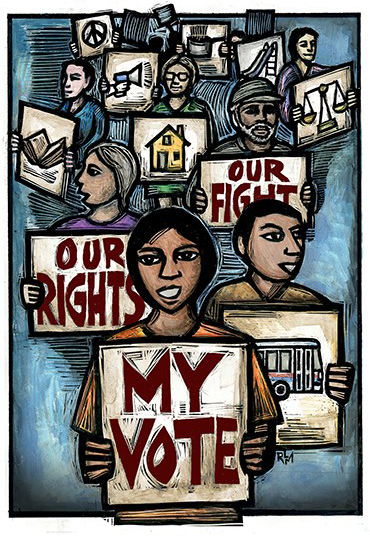
As a social movement historian, I think we should focus more on the missing 21st century voters in American elections. Close to 90 million Americans, more than a third of the eligible voting age population, did not vote. This number is greater than the number of people who voted for either Donald Trump or Kamala Harris.
A recent post-election piece in The Guardian, avoids the typical hectoring tone about non-voters in the United States (don’t they know that this election is the most consequential of their lives?!) Instead, The Guardian asked non-voters why they did not vote — and took them seriously.(8)
To paraphrase Jedidaja Otte, the author of the piece, a large number of people abstained from voting because they felt neither candidate represented their interests, including several who voted in the previous two elections.
Others felt their vote would not matter because of how the Electoral College system functioned, and Democratic voters cited the Harris campaign’s stance on Israel or climate issues as the reason for their abstention.
Latinos/as were especially disturbed at the U.S. support for Israel’s genocidal war against Palestine. An Axios-Ipsos Latino Poll conducted in partnership with Noticias Telemundo during the 2024 presidential primaries found that “just 16% of respondents said the U.S. should continue to support Israel with arms and funds.”
Nearly every analysis of the 2024 Presidential Election forgot that around 10 million working-class Latinas/os were excluded from the process altogether. While barred from participating formally in politics, Latinx workers are not apolitical. In fact, since the November 2024 elections they have engaged in a broad array of protest actions.
These have included hunger strikes, boycotts, rallies, teach-ins, and “stay-at-home” actions. They responded to Migrant Day Labor Network’s call for the December 18, 2024 Day of Action and Solidarity to coincide with the United Nations’ International Migrants Day, holding demonstrations in Los Angeles, Houston, Philadelphia, Trenton and elsewhere.
Less than two weeks after Trump’s inauguration, a national “Day without Immigrants” erupted across the country. There were actions in 120 cities across 40 states and Puerto Rico. Grassroots participation was so widespread that many businesses shuttered in solidarity with the protests.
Even with Trump’s occupations of Los Angeles, Chicago, Oakland and Charlotte, Latinx people have found the community stands with them.
The Day without Immigrants actions constitute part of a long history of Latinx labor and political organizing going back to the 19th century. In fact, the Juan Crow system of Latinx disenfranchisement in the 21st century — denying a large portion of the Latina/o working-class people access to economic security, voting rights, and equality under the laws to exploit their labor — echoes the older, anti-Black Jim Crow system.
The struggle, solidarity and movement building in a time of crisis will provide the way out of this anti-union, anti-human maze.
Notes
- Paul Ortiz, “Latino Workers, the 2024 Presidential Election and the Future of the Labor Movement,” Labor Studies Journal, Vol. 50, Issue 2 (June 5, 2025), https://doi.org/10.1177/0160449X251342375
back to text - Suzanne Gamboa, “Afro Latino Scholars and Activists Slam Gov. DeSantis’s dissection of AP African American Studies, NBC News.com, February 4, 2023, https://www.nbcnews.com/news/latino/afro-latinos-desantis-black-ap-studies-rcna69036
back to text - David Sehat, The Jefferson Rule: How the Founding Fathers Became Infallible and Our Politics Inflexible (New York: Simon & Schuster, 2015).
back to text - Gustavus Myers, History of the Supreme Court of the United States (Chicago: Charles H. Kerr & Company, 1912), 7.
back to text - The more recent political theory literature on how ruling-class elites have hijacked democracy builds on earlier traditions of scholarship. Recent titles include: Ari Berman, Minority Rule: The Right-Wing Attack on the Will of the People—and the fight to Resist It (New York: Farrar, Straus and Giroux, 2024); Steven Levitsky & Daniel Ziblatt, Tyranny of the Minority: Why American Democracy Reached the Breaking Point (New York: Crown, 2023). Older titles include, Sheldon S. Wolin, Democracy Incorporated: Managed Democracy and the Spectrum of Inverted Totalitarianism (Princeton University Press, 2008), and Walter Karp, Liberty Under Seige (New York: Franklin Square Press, 1988).
- Thurgood Marshall, “The Bicentennial Speech,” May 6, 1987, http://thurgoodmarshall.com/the-bicentennial-speech/
back to text - https://www.theguardian.com/us-news/2024/dec/13/why-eligible-voters-did-not-vote
back to text
6. J. Allen Smith, The Spirit of American Government: A Study of the Constitution, Its Origin, Influence and Relation to Democracy (London: Macmillan & Co., 1907), 135-136.
January-February 2026, ATC 240