Against the Current, No. 240, January/February 2026

-
Racial Injustice Inferno
— The Editors -
Vanity Vandalism: Trump's Versailles on the Potomac
— Michael Steven Smith -
Homelessness Safety Net in Tatters
— Louise Gooden -
After the 2024 Elections: Where Do We Go from Here?
— Paul Ortiz -
A New McCarthyism?
— Kristian Williams -
Retrieving History: Ukrainian People's Republic
— Vladyslav Starodubtsev -
Chile: Rise of the Far Right
— Oscar Mendoza -
A Dissident's Dilemma: Albert Maltz's Rediscovered Novel
— Patrick Chura - The Black Struggle
-
Taxation without Representation
— Malik Miah -
Freedom Train and Worker Solidarity
— Paul Prescod -
An American Betrayal of Trust
— Joel Wendland-Liu -
Sinners: The Power of Connections
— Frann Michel -
Trump's Latest Racist Tirade
— Malik Miah - Vietnam
-
An Antiwar GI's Story
— an interview with Howard Petrick -
Researching a Movement
— an interview with Martin J. Murray - Reviews
-
On Ernest Mandel's Contributions
— Paul Le Blanc -
Jewish Anti-Zionism in Perspective
— Lex Eisenberg -
Parchman Life Unfiltered
— Marlaina Leppert-Miller - Parchman Life Unfiltered
-
Serious History in Comix
— Hank Kennedy - In Memoriam
-
Patrick Michael Quinn 1942-2025
— Robert Bartlett
Kristian Williams
WHEN I TITLED this talk “A New McCarthyism?” I had in mind some of the recent, shocking attacks against free speech, particularly those centered on educational institutions and the media.
As the Federal Communications Commission investigated news networks, Trump filed spurious lawsuits and interfered with the business dealings of their parent companies, leading to an observable rightward drift in coverage. Similar tactics led Columbia University to agree, in effect, to federal oversight of the curriculum, while many other institutions have raced to comply in advance, hoping to avoid the same sort of trouble.
Besides these, there are attacks against lawyers and law firms who represent disfavored clients; mass firings of federal employees, especially in oversight agencies, to be replaced with political operatives; and the use of the Internal Revenue Service, regulatory agencies, and sometimes the Justice Department to punish political enemies.
After the September 10 assassination of Charlie Kirk, though the cancellation — and subsequent de-cancellation — of Jimmy Kimmel got all the headlines, censorship was quickly expanded to ordinary people, those outside the public eye, who dared to criticize the now sainted Far Right activist.
Rightwing influencers assembled blacklists of “Charlie’s murderers” and pursued widespread doxing campaigns. Teachers, firefighters, agents of the Secret Service, and members of the military were all dismissed after commenting on the affair. Private companies — especially airlines, for some reason — similarly disciplined employees.
One reporter was terminated after he asked a member of Congress whether the Kirk shooting had changed his thinking about gun rights. DC Comics cancelled Gretchen Felker-Martin’s Red Hood because of her criticisms of Kirk.
At least forty faculty members, staff, or students at colleges or universities were disciplined, sometimes for comparing Kirk’s assassination to other school shootings. Many were penalized simply for quoting Kirk’s own words.
One professor was fired for posting a headline from Newsweek. And the State Department promised to deport immigrants seen as “praising, rationalizing, or making light of Kirk’s death.”
“Free Speech” Fakery
It’s been pointed out, repeatedly and maybe too smugly, that this is a weird turn for those on the right who just a few weeks before were casting themselves as the defenders of free speech, and that it resembles the much decried “cancel culture” of the left.
I say that this observation is too smug not because it is wrong exactly, but because it omits more than it captures — the right’s claims about defending free speech ought never to have been taken seriously.
Self-described “free speech absolutist” Elon Musk sees no difficulty in firing workers who advocate unionization, to say nothing of his efforts to tilt the playing field on the internet platform he owns, the site formerly known as Twitter. Other of these famous free speech crusaders — including Bari Weiss and Charlie Kirk himself — built their careers by organizing watch lists or otherwise monitoring the political views of college professors.
Furthermore, and more importantly, unlike cancel culture the current efforts are being driven by the federal government. In this respect, they more closely resemble McCarthyism.
The McCarthyite Specter
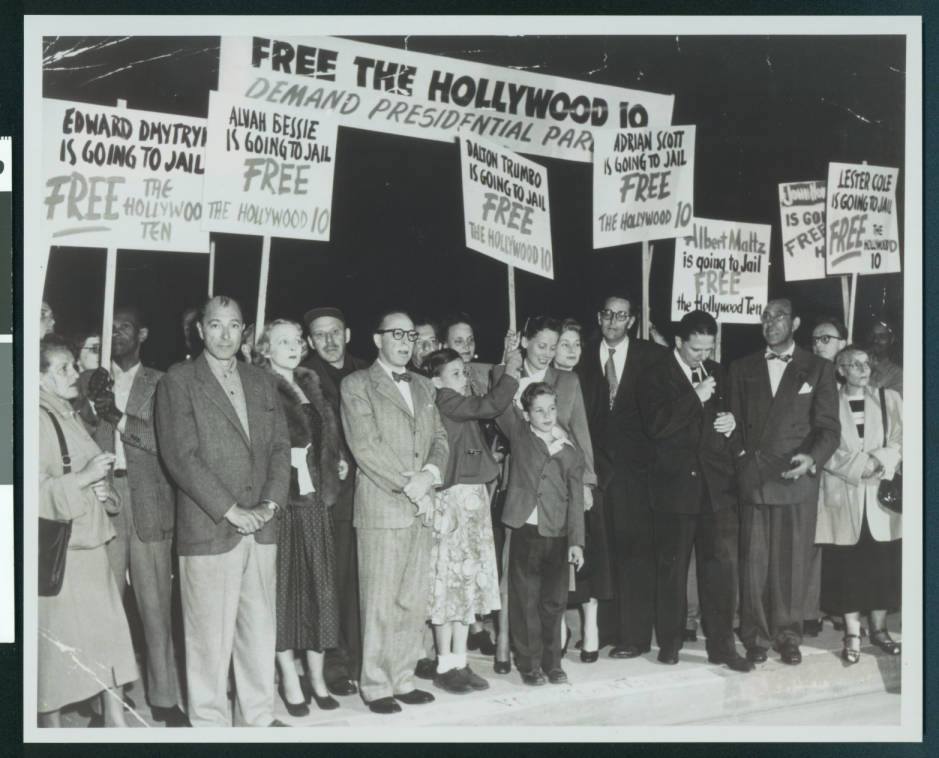
In the late 1940s and early ’50s, at the outset of the Cold War, conservatives in government used the fear of Communism to opportunistically target their political enemies — not only Communists, but labor unions, the nascent Civil Rights movement, advocates of the New Deal, and defenders of the Bill of Rights.
Some were summoned to public hearings to be questioned, chastised, and humiliated; others were named in secret files that the FBI provided to colleges, employers, and journalists. Hundreds went to prison for refusing to cooperate. Thousands lost jobs, many driven out of their professions altogether.
The federal government required its workers to sign loyalty oaths; other organizations soon followed suit. Unions purged radicals from their membership. Bertolt Brecht fled the country. Charlie Chaplin was denied entry. Julius and Ethel Rosenberg were executed.
There is a similarity in style, which may be attributable to the influence of Roy Cohn — McCarthy’s lieutenant and Trump’s mentor. Both McCarthy and Trump told lies at such a pace that fact-checking became impossible if not actually pointless.
Both fabricated threats and libeled their critics, and provoked controversies in order to generate publicity. In all these aspects, then and now, the press was heavily complicit. Both McCarthy and Trump alienated traditional Republicans, though both also intimidated them into either remaining silent or joining the paranoid chorus.
In the ’50s as today, the red scare bled over into a lavender scare targeting sexual minorities.
I trust the formal resemblance is clear enough. But to understand why I frame our present crisis as “return to McCarthyism?” it’s important to understand how the Trump administration has broken from the previous half-century of repressive practice — and even more so, theory.
As devastating as McCarthyism was, both to the individual victims whose lives it ruined and to the left more broadly, it was also a rather spectacular failure.
It did not prevent the rise and growth of the Civil Rights movement, or the antiwar movement and the New Left more broadly. As those movements grew, the government resorted to more and more drastic measures to repress them, most notoriously under the FBI’s COINTELPRO efforts — employing tactics up to and including false imprisonment and murder.
The Turn to Counterinsurgency
In the period after the 1960s, domestic law enforcement increasingly turned to a military approach called counterinsurgency. This resulted in two contrasting but complementary developments: the militarization of police in terms of tactics, equipment, and organization; and the adoption of “community policing” — an approach that emphasizes friendly contact with the citizens and collaborative relationships with community organizations.
The main objective in counterinsurgency, as outlined in U.S. military doctrine, is legitimacy — that is, public support for the government. Winning that support requires that the government be responsive to the public’s demands, meet the needs of the population, and carefully co-opt leadership that might otherwise develop into an oppositional movement.
The use of coercive measures, and especially violence, would be restrained and directed narrowly against the recalcitrant militants. The approach here is to divide the radicals from their base of support in the population. In this effort, British Brigadier Frank Kitson wrote:
“The ideal allies for a government implementing control are, in fact, nonviolent members of the community the would-be insurgents seek to mobilize. Strong moderate forces can be interlocutors to the community in general and an alternative for political action that does not involve violence.
“If moderates side with the government, they can provide superb intelligence on radical activities…. If regimes can infiltrate — or, better yet, cooperate with — mainstream groups they are often able to gain information on radical activities and turn potential militants away from violence.”
Counterinsurgency relied on a vast quantity of intelligence, not only about the insurgent networks, but about the society as a whole — how it is structured, where power resides, how legitimacy can be cultivated. Its theorists saw the causes of unrest in the nature and structure of the society itself, and thus moved away from Hoover and McCarthy-style conspiracy theories, which tended to see discontent and dissent as the product of a secret Communist plot.
“Terroristic Conspiracies” Everywhere
It is at this theoretical level that the greatest reversal has recently occurred. About two weeks after Kirk’s death, on September 22, Trump issued a proclamation designating Antifa as a “terrorist organization.”
Three days later, September 25, Trump signed National Security Presidential Memorandum/NSPM-7, announcing “a new law enforcement strategy that investigates all participants in these criminal and terroristic conspiracies — including the organizational structures, networks, entities, organizations, funding sources, and predicate actions behind them.”
Under this strategy, the authorities should “investigate and disrupt networks, entities, and organizations that foment political violence so that law enforcement can intervene in criminal conspiracies before they result in violent political acts.”
This preventive strategy will follow “specific guidance” provided by the attorney general, which prioritizes “politically motivated terrorist acts such as organized doxing campaigns, swatting, rioting, looting, trespass, assault, destruction of property, threats of violence, and civil disorder.”
In addition to this rather dubious list — trespass is not ordinarily considered violence, much less terrorism, and doxing is generally protected by the first amendment — “This guidance shall also include an identification of any behaviors, fact patterns, recurrent motivations or other indicia common to organizations and entities that coordinate these acts.”
Elsewhere the same document identifies these features in explicitly ideological terms:
“There are common recurrent motivations and indicia uniting this pattern of violent and terroristic activities under the umbrella of self-described ‘anti-fascism.’ . . . Common threads animating this violent conduct include anti-Americanism, anti-capitalism, and anti- Christianity; support for the overthrown of the United States Government; extremism on migration, race, and gender; and hostility towards those who hold traditional American visions of family, religion, and morality.”
Furthermore, where the counterinsurgency/community police model treated nonprofits and Non-Governmental Organizations as potential partners for the regime, and insurgent theorists have critiqued them as mechanisms for containing opposition and channeling it into manageable (and usually reformist) projects, NSPM-7 mandates that terrorism investigations target “institutional and individual funders, and officers and employees of organizations that are responsible for, sponsor, or otherwise aid and abet the principal actors.”
All Opposition Criminalized
Where counterinsurgency sought to make careful distinctions between the implacable radicals (who must be met with force) and the more tepid moderates (who could be placated with concessions or coopted into the apparatus of the state), Trump and his people deny any distinctions between Antifa and other activists, unaffiliated radicals, the Democratic Party, or even serious-minded judges.
Trump seems to believe that “Antifa” is behind any resistance to his agenda and, by the miracle of circular reasoning, any opposition to Trump’s agenda therefore provides the grounds to label a person as Antifa. This isn’t even guilt by association, since no actual association is necessary.
For example: under the first Trump administration, during the riots of 2020, the leadership of the Department of Homeland Security insisted, over the objections of their own analysists, that Antifa was orchestrating the unrest.
The available evidence said otherwise, but from the perspective of those in charge, conclusions don’t follow from evidence; evidence is selected or suppressed, as needed, to support a pre-ordained conclusion. Where counterinsurgency took a sociological approach to understanding insurgent networks, here we see a full return to conspiracy thinking.
Welcome to the Occupation
All of this is ridiculous and absurd, but no less dangerous for all that. And while I think I’ve made a solid case that at least certain parts of the government are moving away from counterinsurgency — toward something that more closely resembles McCarthyism — I also don’t think that McCarthyism quite captures everything that is happening. So the question mark in my title is also important.
In addition to the blacklisting and censorship I have already mentioned, and the detention and deportation of certain political opponents, there are also the vast number of ICE raids targeting immigrant, or often just Latino, communities as a whole.
When these raids are met with resistance, or even token demonstrations as have occurred recently in Portland, the impulse then is to send in the military. That element is not familiar from McCarthyism; it is in fact something worse.
It may not have an “ism,” but the use of the military for domestic repression has a long and bloody history. Soldiers were used against striking workers, from the 1870s to the 1930s; against anti-war protestors from World War I to Vietnam; against Black urban rebellions as recently as 2020; and perhaps more than anything else, against Native Americans as they resisted displacement and dispossession.
Reliance on the military for such purposes has decreased over the past century, and that is by design. What the military can bring is overwhelming force, but as the theory underlying counterinsurgency makes clear, that often comes at the expense of legitimacy. A military occupation is a clear indicator that democracy is breaking down, at least in that particular time and place.
It was long ago decided that local police are best poised to handle the main work of political repression. Partly that is for practical reasons: they are closer to and have more intimate knowledge the local circumstances. But it’s partly for political reasons: military involvement is viewed as discrediting, both to the operation and to the military itself.
The military remains one of the few trusted institutions in our society, and to a large degree that is because it has been seen not to be a partisan weapon. Trump’s approach endangers that trust.
This brings us to what is likely the largest break from the theory of counterinsurgency. Under counterinsurgency, the main objective is legitimacy, which is understood as flowing from public support.
Trump does not care about legitimacy, or not in the same way. He is reversing the relationship between legitimacy and power, assuming that legitimacy follows from power rather than the other way around. He believes that support is just another form of obedience. If he can compel praise and silence criticism, what difference does it make what people think, or feel, or want?
Counterinsurgency suggests that these things matter because people have a tendency to take action on their own behalf, and the stability of society requires that its rulers take the population’s needs into account.
Trump is betting that power alone is enough to sustain his power indefinitely. Everything depends on proving him wrong.
No Cooperation!
One weakness in Trump’s approach is that it actually depends on a great deal of unforced cooperation. I don’t mean enthusiastic engagement; I mean complying with new rules prior to any enforcement, or trying to anticipate future demands so as to avoid trouble.
In the short term, from the perspective of an individual administrator, or even an institution, this may seem like a rational choice in terms of minimizing hassle and maximizing rewards. But in even the medium term, it cedes far too much to the government; scaled up across the society, the consequences are disastrous — increasing centralized control and authoritarianism, tending toward totalitarianism.
Faced with new government demands, spoken or unspoken, institutions’ correct response, as John Oliver recently put it, is: “Fuck you. Make me.” We’ve recently seen some encouraging signs in this direction.
Airports across the country refused to play a videotaped message from Homeland Security Director (and proud puppy-killer) Kristi Noem blaming delays on Democrats. Every news outlet but one refused to agree to new restrictions on covering the Pentagon.
A number of universities have rejected the President’s new requirements about hiring, admissions and curricula. City, county and state governments have doubled down on their sanctuary laws, enacting more rigorous policies against cooperation with the immigration authorities.
Beyond this, individual officials and even workers have engaged in a range of stonewalling, sandbagging, and foot-dragging, bordering on outright sabotage. I personally know of one local official who, rather than refuse to help ICE outright, sent them on a long and fruitless hunt to borrow a piece of equipment from an office that he knew did not exist.
I have to imagine there are hundreds of such examples happening all the time, under the radar, across the country. There is a reason that the Office of Strategic Service’s simple sabotage manual has gone viral in the last few months.
That said, relatively few of us are going to find ourselves faced with the kinds of decisions about compliance or collaboration that university presidents or mayors might confront.
Our role, in those situations, it to encourage those officials to hold to principle, to make it clear that public support will be behind them if they do, even if it entails sacrifices, and equally that the public will hold them accountable if they fold. Sometimes this will take the form of moral suasion and gentle pressure, but sometimes it will mean making them the object of public protest and disruptive action, of exacting costs for their cowardice.
At the same time, it is vital that those opposed to Trump’s agenda take the initiative. The recent No Kings rallies did an important job in showing officials and the “broader public” — including the demonstrators themselves — the extent of opposition. They broke the paralyzing isolation many people felt, and should encourage further and more direct action.
Communities across the country are already organizing rapid response networks to mobilize against ICE raids. These may not be enough to stop the raids but they do slow them down and make them more costly.
That should be paired with disruptive action — boycotts, pickets, strikes, mass civil disobedience — to disrupt the logistics and infrastructure of repression. This strategy conceives the struggle against Trump not as one big fight with one big solution, but as lots of little fights with lots of little solutions.
There may well be a single dramatic moment that signals the end of the Trump era, as the Army hearings signaled the end of Joe McCarthy’s reign of terror, but that final blow will have been preceded by innumerable, minor, and largely unreported moments of refusal.
In this regard, all the small occasions of resistance are part of a larger fight, and their importance cannot be understood in isolation. It is probably not a single immovable obstacle, or an equal and opposing force, but the constant friction and the sand in the gears that will, with increasing efficacy, stop the advance of the juggernaut.
January-February 2026, ATC 240