Against the Current, No. 240, January/February 2026

-
Racial Injustice Inferno
— The Editors -
Vanity Vandalism: Trump's Versailles on the Potomac
— Michael Steven Smith -
Homelessness Safety Net in Tatters
— Louise Gooden -
After the 2024 Elections: Where Do We Go from Here?
— Paul Ortiz -
A New McCarthyism?
— Kristian Williams -
Retrieving History: Ukrainian People's Republic
— Vladyslav Starodubtsev -
Chile: Rise of the Far Right
— Oscar Mendoza -
A Dissident's Dilemma: Albert Maltz's Rediscovered Novel
— Patrick Chura - The Black Struggle
-
Taxation without Representation
— Malik Miah -
Freedom Train and Worker Solidarity
— Paul Prescod -
An American Betrayal of Trust
— Joel Wendland-Liu -
Sinners: The Power of Connections
— Frann Michel -
Trump's Latest Racist Tirade
— Malik Miah - Vietnam
-
An Antiwar GI's Story
— an interview with Howard Petrick -
Researching a Movement
— an interview with Martin J. Murray - Reviews
-
On Ernest Mandel's Contributions
— Paul Le Blanc -
Jewish Anti-Zionism in Perspective
— Lex Eisenberg -
Parchman Life Unfiltered
— Marlaina Leppert-Miller - Parchman Life Unfiltered
-
Serious History in Comix
— Hank Kennedy - In Memoriam
-
Patrick Michael Quinn 1942-2025
— Robert Bartlett
Hank Kennedy
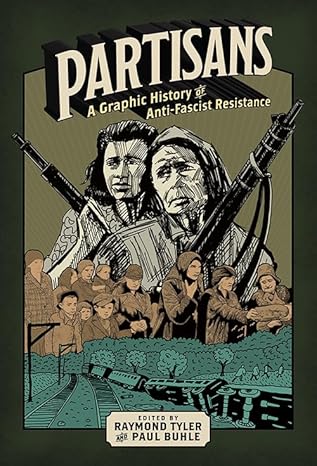
Partisans:
A Graphic History of Anti-Fascist Resistance
Raymond Tyler and Paul Buhle, eds.
Between the Lines, 2025, 148 pages. $25.99 paper.
IT’S AMAZING HOW much history one can learn from comic books. I first encountered World War II’s antifascist partisans in the reprints of Stan Lee and Jack Kirby’s Sgt. Fury and his Howling Commandos.
The first issue of the Marvel war comic featured the cigar chomping sergeant and his multi-ethnic, multiracial squad on a secret mission into Nazi occupied France, where they are assisted by the French resistance. Together, they rescue a French freedom fighter with knowledge of the D-Day invasion from the hands of the Nazis in a rip-roaring war yarn, quite typical of the 1960s.
At the time I read the comic, the history of the antifascist resistance was consciously downplayed in public discourse. In an insult swiped from the Simpsons, the French were called “cheese-eating surrender monkeys” over their alleged cowardice for failing to follow George W. Bush on his Iraqi crusade.
Even superheroes who fought in the Second World War and should therefore have known better were not immune. In 2003’s The Ultimates Captain America responded to a request for surrender from an alien conqueror with this bit of inanity: “Surrender? You think this letter on my head stands for France?”
Although several decades older, the stories of Sergeant Fury and the Howlers presented a more accurate picture of events.
Comix Chronicling Resistance
Partisans: A Graphic History of Anti-Fascist Resistance, edited by Raymond Tyler and Paul Buhle, tells the story of resistance to fascism not just in France, perhaps the most famous site of wartime resistance, but across the European continent. A talented bunch of writers and artists have been assembled for the task, including the late underground comix legend Trina Robbins. Each creative team relays a single story.
Tyler and Buhle present a history of fascism in their introduction. They attempt a neat formulation tying the efforts to save the anarchists Sacco and Vanzetti, convicted of murder and sentenced to death, to opposition to Italian dictator Benito Mussolini.
Buhle and Tyler write that the two anarchists’ “resounding martyrdom…carried over into marches and commemorations across the world, markedly in opposition to everything that Mussolini seemed to represent.” It’s a clever try, undone only by the fact that Mussolini actually made an effort to save Sacco and Vanzetti from the electric chair in a bit of misplaced national kinship.
The artistic styles at hand vary. Gary Dumm and Anne Timmons have a classic style that comes closest to the aforementioned Sgt. Fury or other period war comics. Seth Tobocman, a mainstay of World War 3 Illustrated, in his section on the Yugoslav partisans, evokes socialist agitprop with his harsh, blocky figures.
David Lester’s scratchy drawings have a roughness and immediacy to them. Sharon Rudahl’s pieces use pleasant watercolors to show the fighters in the Spanish Civil War and Josephine Baker, the international dancing superstar who became a decorated French Resistance spy during WWII and subsequently a pivotal Civil Rights activist.
Some stories come from the creators’ personal experiences. Sander Feinberg’s portion on Hungary with Summer McClinton is framed as a story he’s telling to his granddaughter. Isabella Bannerman’s childlike illustrations recreate the atmosphere of her mother’s childhood WWII experiences. Franca Bannerman, Luisi Cetti and Isabella Bannerman relay Franca’s childhood, where she was first enamored with Mussolini but grew rebellious against Italian fascism. Other sections detail the histories of whole resistance groups in particular countries or among exiles.
Shortcomings
The political shortcomings of Partisans are apparent to those who know the history of the Allied Powers’ World War II grand strategy in Europe. For those who don’t, Gabriel Kolko’s revisionist The Politics of War: The World and United States Foreign Policy, 1943-1945 is a useful introduction.
In short, although many Communists believed that resistance against fascism would precede a triumphant rising against capitalism, the Allied Powers, including the Soviets worked to ensure this was not to be. Instead, the partisans disarmed and the Communists adapted themselves to bourgeois democracy.
As Kolko wrote, the “U.S.S.R. demanded and assiduously enforced [a reformist strategy] where it controlled local Communist parties and, through them, the Resistance. It brought an end to the illusions of possibilities and national renovation that inspired the European Resistance.”
It is only Daniel Selig’s piece on the French resistance that adds any of this global context. The rest are largely uncritical of the strategy of the partisan movements.
What’s more, lack of context gives readers the false impression that the fight against European fascism was over with the end of World War II. David Lester’s section on the Greek EAM (National Liberation Army) proclaims “the Axis occupation of Greece ends in 1944.”
But the fighting did not end there. When British troops nominally on the same side as the EAM rolled into Greece, Winston Churchill instructed their commanding officer to behave “as if you were in a conquered city where a local rebellion is in progress.”
Great Britain and the United States together supported an ultimately victorious force of right-wing monarchists and Nazi collaborators in the brutal Greek Civil War. History was thus quite different from the clear-cut victory presented in the comic.
While Partisans has certain shortcomings in its politics and history, it is never boring. Buhle is an old hand at these historical compendiums, starting with 2005’s Wobblies!: A Graphic History of the Industrial Workers of the World. He always assembles an amazingly talented team that gives each section a unique identity and feel. Partisans is no exception.
Partisans comes at a precipitous time in U.S. politics. President Trump is currently launching a new Red Scare — or should that be black-and-red scare? — over antifascism in general and Antifa specifically. The Trumpian Right have created an image of antifascists as sinister conspirators, who chortle as they plot to destroy baseball, mom and apple pie.
This comic shows that anyone could be an antifascist, so long as they are willing to rebel. They could be your friends, your family, or your neighbors and coworkers.
Not all of those rebels carried a gun, either. Writers publishing underground newspapers, spies with their eyes and ears open, and people willing to open their homes to enemies of the fascist state were all part of the partisan resistance. Regardless of the specificities of the actions, all showed great moral, physical, and political courage.
In Hemingway’s For Whom the Bell Tolls, protagonist Robert Jordan is asked about the potential for fascism in the United States. He responds, “There are many who do not know they are fascists but will find it out when the time comes.”
There are also many Americans who do not know they are antifascists, but need to find it out; the sooner they do so, the better. Partisans, with luck, can help speed the process along.
January-February 2026, ATC 240