
Against the Current, No. 243, July/August 2026

-
Toward Liberation or Ruin?
— The Editors -
Opening the Door to the Far Right: German McCarthyism Redux?
— Annette Ohme-Reinicke -
U.S. vs. China Hegemony in Taiwan
— Red Mole -
Past to Present and Possible Futures(1)
— Harvey J. Graff -
Remembering a Resister
— Thomas Abowd -
Trump-Netanyahu Debacle
— David Finkel - Antifascist Conference Roundup
-
Porto Alegre Report: Ecosocialism or Class Compromise?
— Ivan Drury Zarin -
For Anti-colonial Solidarity
— Rafael Bernabe -
Resisting Rising Fascism: People's Anti-imperialism Solidarity
— Sushovan Dhar -
Anti-racism, Feminism, Fascism and Civil Rights
— Mireille Fanon-Mendès France - Essay
-
Langston Hughes, Nationalism & the Internationalist Horizon: Viewing America at 250
— Juan J. Rodríguez Barrera - Reviews
-
The Rise and Fate of a Movement
— Steve Downs -
Malcolm as Revolutionary and Icon
— Malik Miah -
The Violence of Political Policing
— Michael Principe -
Memoir: Uplifting a Movement
— Carol Hayse -
Fighting Fascism: An Unequal Guide
— Hank Kennedy -
The Cultural Vanguard Is Antifascist
— Paula Rabinowitz -
The Making of a Menace
— Guy Miller -
Demythologizing Colonial Conquest
— Frann Michel - In Memorium
-
Abra Quinn (1966-2025)
— Adam Hefty
Carol Hayse
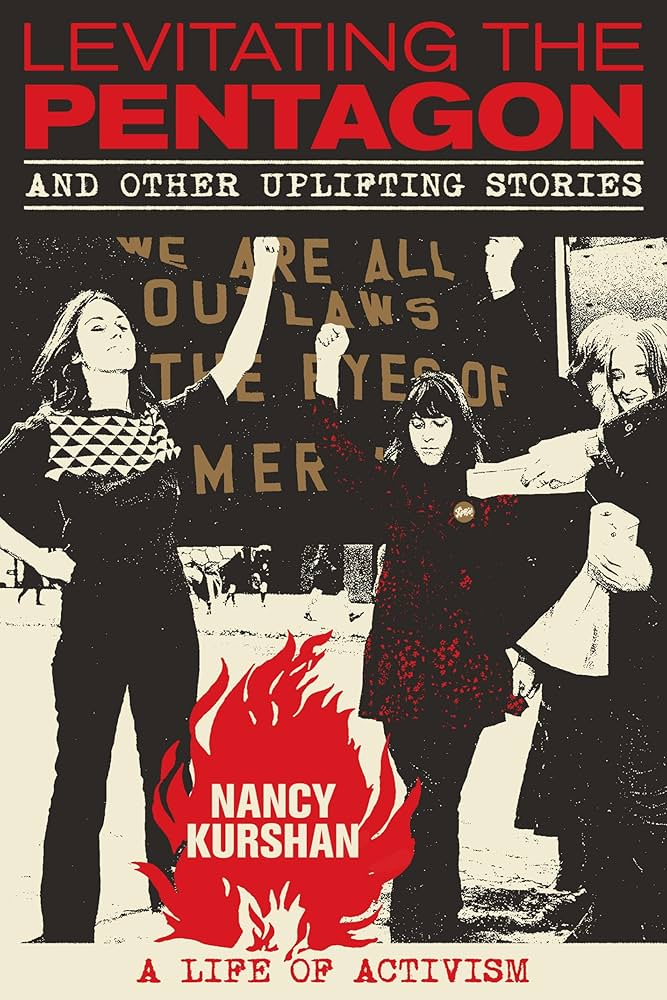
Levitating the Pentagon and Other Uplifting Stories:
A Life of Activism
By Nancy Kurshan
Three Rooms Press, 2026, 352 pages, $22 paper.
RARELY IN THE life of an organizer are we affirmed for our efforts in a public and tangible way — when we get to see what our struggles have produced and feel that we have accomplished something worthwhile.
We usually see the part, not the whole perhaps, and think that what we have done may not have changed the world, but was confused, disorderly, and partial. The Chicago Teachers’ Union strike of 2012, which broke “bowling league” unionism and began an assault on neoliberalism, was such a moment.
Another such moment was experienced by Nancy Kurshan when she and other peace activists were invited back to Vietnam on the anniversary of the signing of the Paris Peace Accords. She was thrilled and affirmed to be embraced by the powerful Madam Binh, who had succeeded in staring down Henry Kissinger in negotiations.
A “red diaper baby,” Nancy was raised among people who took worker organizing and opposition to government policies out into the street. She emerged into organizing as a young adult in the early ’60s, into the counterculture and into the Peace Movement.
Much of Nancy’s countercultural work centered on the Yippees, an anarchist-like grouping who mounted events filled with humor and satire to expose the government. As a principal in that movement, she, Jerry Rubin, Abbie Hoffman and others were central to the trial of “The Chicago 8” that had arisen out of protests aimed at the 1968 Democratic Convention.
The Yippees were also responsible for a highly successful peaceful assault (1967) on the Pentagon. The levitation did not appear to succeed(!), but in spite of that the Pentagon retreated from most of its threats. And to give the counterculture its due, such exuberant satire attracted disaffected white youth more robustly than did most of the rest of the left.
Franz Fanon, C.L. R. James and other such thinkers influenced Nancy in that era. And as years with the Yippees taught Nancy its limitations, she leaned into other ways of opposing the Vietnam War, colonialism and white supremacy.
Protest to Resistance
She moved from protest to resistance and associated herself with the Weather Underground Organization, and later the Prairie Fire Organizing Committee. As supporters of antiracist direct action PFOC logically associated itself with Puerto Rican Independence work, and with prison abolition efforts. Nancy did seminal work in these arenas for many years. The throughline of all of these efforts was anti-imperialism, feminism and antiracism.
Nancy story-tells her life with humor, clarity, and honesty. She warmly shares stories of life with her two husbands, and the untraditional ways her children were raised.
She shares her personal and political development and reflects candidly on mistakes. For instance, she remarks on the failure of “our (part of the movement’s) inability to develop an anti-racist class perspective that appealed to the white working class.”
She notes with pride that PFOC developed probably the most authentic and advanced feminist practice on the left, and was influential in placing anti-racist work on the agenda for much of the left.
Of course Nancy shares the despair of all of us at the current U.S. moment. But her decades of anti-imperialist organizing have provided a foundation for understanding of some of the paths that must be taken now. A political life to be celebrated.
(Afterword: Nancy currently works in “1000 Grandmothers” addressing the climate crisis.)
July-August 2026, ATC 243