
Against the Current, No. 245, November/December 2026

-
Confronting Rampant Repression
— The Editors -
Different Soil, Similar Weather & Familiar Seeds: Serbia to Minnesota
— Mihailo Vučetić -
America's Detention Nightmare
— Suzi Weissman interviews John Washington - France's Student Eruption
-
A Month to Prepare for the General Strike
— Kit Adam Wainer -
Indian State Wages War on Citizens
— Kunal Chattopadhyay -
Double Standards, Imperial Hypocrisy 25 Years After 9/11 – What Has Changed?
— Val Moghadam -
Fighting Fascism in the Trump Era
— Ken Lawrence -
German Trial of Pro-Palestinian Activists
— Martin Oppenheimer - The Trump-Putin Axis
- Essay
-
The Rise of Democratic Socialists: Democratic Discontent
— Kim Moody - Reviews
-
A Movement’s Inspiration and Legacy
— Francis Shor -
From Movement to State Ideology
— Donald Greenspon -
From Buczacz to Palestine: An Historian's Journey
— David Finkel -
Bolshevik Rule During the Civil War
— Samuel Farber -
Rosa Luxemburg's Radical Ecology
— Paul Le Blanc -
Global Heating on the Ground
— Mike McCallister -
A Chapter of Texas Radicalism
— Folko Mueller -
The Zany Comedy of I Love Boosters
— Frann Michel
Kunal Chattopadhyay
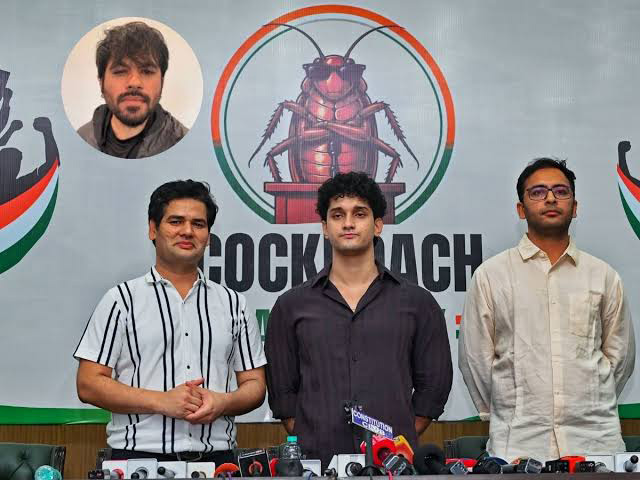
[Massive protests erupted again in India — only months after student mobilizations forced the resignation of the Education Minister — this time over the Modi government Election Commission’s cancellation of 130 million voters’ registrations, a massive purge that must be turning Donald Trump green with envy. After initial actions by the youth “Cockroach Janata Party” movement were suppressed, mainstream opposition parties joined the protests.
Prominent opposition figures including Indian National Congress lawmaker Priyanka Gandhi Vadra and leader Rahul Gandhi as well as CJP leaders such as Ashutosh Ranka, Saurav Das and Ajinkya Shinde, were arrested (“detained”). In view of the global significance of this upheaval, we are glad to publish the following in-depth analysis by Kunal Chattopadhyay. His work has appeared in previous issues of ATC and on our website.]
THE ONGOING CRACKDOWN by the Indian state against mass popular mobilizations in New Delhi and across major urban centers represents an aggressive escalation in its longstanding assault on democratic rights.
What began as scattered grievances over administrative overreach, economic stagnation and systemic exam leaks (forcing students to re-take the high-stress examinations — ed.) has coalesced into a national confrontation.
The state’s response has not been one of democratic engagement, but of naked coercion: mass police detentions, preventive roundups of youth organizers, the blockade of transport networks, and the militarization of public spaces.
Historically designated protest grounds like Jantar Mantar, alongside public institutions such as Akashvani Bhavan, have been transformed into fortified zones surrounded by multi-layered steel barricades, riot police, and paramilitary personnel drawn from sensitive border territories.
In the capital, the cancellation of long-distance passenger trains and the systematic shutdown of dozens of metro stations serve a single operational purpose: to physically serve the working masses, students, and rural migrants from the political center of the nation.
A call was given to gather for a mass protest on 10 October 2026 demanding the resignation of the Chief Election Commissioner, Gyanesh Kumar, exposed for his illegal activities (mass purge of electoral rolls, discussed below). This has been treated as a movement for regime change, accused of being “foreign funded,” and attacked with the entire might of the coercive apparatus.
State Repression: A Crisis of Legitimacy
Under the pretext of preserving “public order” and ensuring “public safety,” the ruling apparatus has deployed coercive state instruments against peaceful assemblies of citizens, parliamentarians, and student activists.
Yet far from demonstrating the structural strength or self-assurance of the state, this heavy reliance on police power signals a crisis of political legitimacy. When a government must deploy thousands of armed personnel, and declare vast swathes of its capital off-limits to block citizens from approaching the Election Commission of India (ECI), it implicitly reveals that the ideological consent upon which its hegemony relies has worn thin.
The state is forced to govern through administrative decree and raw police force.
The events in Delhi on 10 October raise questions that go beyond the conduct of individual police officers. The state mobilized its administrative and coercive resources to prevent a political demonstration from taking place. Airport detentions, restrictions on public transport, barricades and mass preventive detention formed parts of a coordinated operation.
The underlying issue was the credibility of the electoral system. The protest demanded the resignation of Chief Election Commissioner Gyanesh Kumar over alleged irregularities in the Special Intensive Revision of electoral rolls.
Instead of facilitating public scrutiny of an institution exercising enormous power over political participation, the authorities sought to prevent citizens from assembling to challenge it. More than 7000 people were “detained,” not “arrested” — a semantic joke.
These allegations (of massive voter suppression, discussed below — ed.) require examination, evidence and public answers. They also provide legitimate grounds for political mobilization.
An election commission’s independence cannot mean immunity from criticism. Its authority depends partly on public confidence that its procedures protect equal political participation.
Democracy requires opportunities to question how electoral rolls are prepared, how exclusions are corrected and how officials exercise their powers. Suppressing those questions through police action weakens the democratic legitimacy that electoral institutions are supposed to sustain.
According to The Indian Express, the permit application for the October 10 protest was submitted on 7 October against a ten-day notice requirement. That explanation deserves consideration, but does not settle whether the subsequent measures were justified.
A procedural dispute cannot by itself justify detaining organizers as their aircraft lands, obstructing travel across the city or rounding up people near possible protest sites. The authorities instead used the permit system to prevent the assembly, turning administrative regulation into a powerful restriction on political participation.
The Capitalist State’s “Order”
The Union home ministry instructed state and Union Territory governments to cooperate with Delhi Police and take preventive steps against protesters travelling to the capital.
This extends responsibility beyond particular police stations. Transport restrictions and coordinated interceptions made the machinery of government an instrument for obstructing collective political action.
Public infrastructure ordinarily enables people to travel, communicate and meet. Its restriction can disperse a movement before participants reach their destination. State coercion therefore operates through control over movement and access as well as through direct physical force.
A Marxist analysis must connect these actions to the capitalist state’s role in maintaining existing relations of power. The state presents itself as representing society as a whole, while preserving a social order structured by unequal ownership, exploitation and concentrated economic power.
This does not mean that every police decision follows an instruction from a capitalist. State institutions possess their own procedures, interests and degrees of autonomy; democratic struggles have also established rights within them.
Nevertheless, those rights become vulnerable when popular mobilization challenges established authority. The events of 10 October expose how readily the defense of public order can become the defense of political incumbency.
The range of people detained reinforces this interpretation. The reports name former chief ministers Pinarayi Vijayan, Mamata Banerjee, Arvind Kejriwal and Manik Sarkar, alongside students, activists, lawyers and journalists.
These politicians have differing programs and records, including records of exercising state power themselves. Their right to protest must nevertheless be defended.
At the same time, prominent names should not obscure the experience of ordinary detainees. For an unknown student or young worker, being taken to an undisclosed location, losing contact with relatives or struggling to obtain legal assistance can have particularly serious consequences.
The reported treatment of attorney Fidel Tom illustrates the danger to legal safeguards. According to The Wire, he went to the Sanjay Colony police post to seek the release of three detained students and was himself detained. The report records allegations that police assaulted him and the students. These allegations require independent investigation.
If a lawyer seeking access to detainees can himself face detention and alleged violence, the means of challenging police power become insecure. The subsequent release of the detained does not resolve questions about what happened to them in custody or who should be held accountable.
Journalism Under Attack
The detention of journalists raises a related question about public scrutiny. Complaints have come from The Quint, Scroll and Newslaundry, including allegations that reporters phones were seized.
Journalists at protest sites document police behavior, preserve testimony and enable official claims to be checked. Removing them weakens these forms of accountability.
Press freedom consequently concerns the public’s ability to know how coercive authority is being exercised in its name. Detaining reporters during a crackdown obstructs that knowledge precisely when it is most necessary.
Reports of assaults by right-wing individuals introduce another disturbing dimension. The material available on the internet includes journalists’ accounts identifying alleged attackers and recording statements justifying violence against protesters.
This establishes collusion between police and those individuals, and demands scrutiny of how far the authorities protected demonstrators and acted against their attackers.
Describing political opponents as “cockroaches” strips them of recognition as citizens entitled to rights. Such language can help legitimize violence. Selective enforcement, if established, would expose the unequal protection underlying claims of impartial public order.
Despite the restrictions, demonstrations emerged at several locations across Delhi, including Dilli Haat and the Safdarjung flyover. The blockade of Jantar Mantar displaced protest without extinguishing it.
That persistence matters, but courage alone cannot overcome organized repression. Democratic resistance needs legal support, reliable documentation and solidarity among workers, students and other citizens.
Electoral accountability must be connected to freedom of assembly, protection in custody and independent reporting. The lesson of 10 October is that democratic rights require organized defense whenever the state obstructs their exercise.
Waiting for the next election leaves unanswered the immediate question of whether people can act collectively to challenge those who govern them.
The Core of Public Anger
At the epicenter of this popular upheaval is a deep and pervasive anger directed at the Election Commission of India and Chief Election Commissioner (CEC) Gyanesh Kumar.
Long celebrated by liberal constitutionalists as an impartial arbiter standing above the political fray, the ECI is increasingly recognized by workers, peasants, students and marginalized communities as an administrative organ integrated into the ruling party’s power structure.
The catalyst for this movement is the Special Intensive Revision (SIR) of electoral rolls. Billed by the state as an administrative “cleanup” of voter databases, the national rollout of the SIR has resulted in the deletion of over 130 million names from draft voter rolls across 30 States and Union Territories.
The scale of this voter disenfranchisement — exceeding the entire population of major industrial nations — has fundamentally altered the electoral landscape.
In state after state, the impact of these deletions has fallen disproportionately on working-class households, migrant labor populations, Dalits, Bahujans and religious minorities.
By weaponizing bureaucratic verification criteria, under the cover of technological modernization, the state has manufactured a mechanism that strips disenfranchised populations of their basic democratic rights.
This crisis of electoral legitimacy stems directly from the implementation of the Special Intensive Revision across the country, where millions of citizens have found their names systematically purged from voter databases.
The administrative drive has provoked a two-fold response: on one side, an unprecedented internal fracture within the constitutional body itself, and on the other, mass street resistance led by student groups, youth movements, and a broad opposition coalition demanding the restoration of voting rights and the removal of top election leadership.
Crucially, the anger on the streets is validated by internal fractures within the Election Commission itself.
An investigative report by The Indian Express exposed that two of the three sitting Election Commissioners, Sukhbir Singh Sandhu and Vivek Joshi, formally recorded at least 14 written dissents over 10 months against decisions executed unilaterally by CEC Gyanesh Kumar.
These dissents documented a pattern of administrative overreach:
• Arbitrary Alteration of Form 6: In May 2025, an unapproved field was added to Form 6 — the statutory application for new voter registration — requiring applicants to state whether they or their ancestors appeared in the “electoral roll of the last SIR.” Despite written warnings from Joshi and Sandhu that changing Form 6 without statutory amendments was “unauthorized and illegal,” the change was retained, blocking countless first-time and young voters from registering.
• Centralization of Digital Architecture: Both dissenting commissioners warned of the “gradual centralization of the electoral roll database” via ERONet and ECINet. They recorded that state-level election officers and statutory Electoral Registration Officers (EROs) — historically the local custodians of voter rolls — were systematically denied full access to the portal. Control was consolidated within the ECI’s central IT division in New Delhi, stripping away the decentralized safeguards that had historically checked centralized electoral tampering.
• Overriding Judicial Directives: In Goa, ground-level EROs found 97 voters eligible following Supreme Court-mandated hearings regarding “logical discrepancies.” Yet, despite eight urgent communications sent by state officials to the ECI IT division requesting software access to restore these names, the central authority refused to enable the rollback option, resulting in the disenfranchisement of eligible citizens.
• Unauthorized Legal Appeals in West Bengal: In West Bengal, where judicial tribunals were formed to hear SIR appeals, Commissioner Sandhu formally queried who had authorized the ECI to file over 1.6 million appeals seeking the deletion of voters whom judicial officers had cleared for inclusion — noting that neither he, Joshi, nor the state’s Chief Electoral Officer had approved these legal actions.*
These internal disclosures demonstrate that the ECI’s neutral constitutional façade has broken down. The systematic override of statutory officers, the arbitrary deployment of unvetted software, and the exclusion of majority opinions within a constitutional body violate Section 18 of the 2023 Election Commissioners Act, which mandates unanimous or majority-based decision-making.
The institutional referee has been converted into an administrative organ of the ruling party at the center.
Ruling Party’s Tacit Admission
In response to the growing mass movement, the ruling Bharatiya Janata Party (BJP) and its sympathetic media channels have launched a campaign to discredit the protests. Protesters, student leaders, and opposition parties have been branded as “anti-national,” “foreign-funded,” and agents of an illegal “regime change” conspiracy to destabilize the nation.
Yet from a critical political perspective, this rhetorical line contains an unintentional admission. By framing protests against the Election Commission as an attempt at “regime change,” the ruling party implicitly acknowledges the complete political alignment between its government and the ECI.
If demanding the resignation of a Chief Election Commissioner or insisting on an audit of compromised voter rolls is treated as an existential threat to the government itself, then the conceptual boundary separating the ruling party from the electoral machinery ceases to exist.
The state’s defense of CEC Gyanesh Kumar is not a defense of constitutional independence; it is the defense of a key operational asset. By equating criticism of the ECI with a treasonous assault on the state, the ruling party confirms the core allegation of the movement: that the Election Commission has been absorbed into the ruling regime, operating not as an independent referee, but as a guarantor of political continuity for the incumbent power structure.
The Movements’ Tactical Strength
A dialectical analysis of the anti-ECI movement requires moving beyond liberal constitutionalist narratives of “saving institutions” to examine the underlying class dynamics, structural forces, and social contradictions driving the crisis.
A rigorous class analysis reveals that the movement is defined by a fundamental contradiction between its tactical strengths and its strategic limitations.
While the movement excels in broad-front mobilization, unifying diverse class interests, and channeling mass youth militancy, it remains constrained by the political hegemony of the bourgeois opposition, which maintains an instrumental view of democratic rights and an inherent propensity for compromise with the capitalist state.
The chief strength of the current political moment lies in the scale, breadth and social composition of the anti-ECI front. The defense of elementary democratic rights — specifically the universal right to vote — has served as a powerful unifying axis, bringing together political forces that were historically divided:
• The Parliamentary Opposition: The coalition unites 19 political parties within the INDIA bloc, spanning national parties like the Indian National Congress to regional parties such as the Samajwadi Party (SP), Aam Aadmi Party (AAP), Rashtriya Janata Dal (RJD), and the All India Trinamool Congress (TMC). Notably, it has drawn in long-standing non-aligned regional entities like Naveen Patnaik’s Biju Janata Dal (BJD), signaling a widening rift between regional bourgeois factions and the centralized federal executive.
• The Left and Student Fronts: Communist and Left parties, including the CPI(M) and CPI(M-L), alongside cadre-based student unions like the All India Students’ Association (AISA), the Students Federation of India, have provided organizational discipline, ideological clarity, and street militancy.
• Spontaneous Youth Movements: The massive participation of the Cockroach Janta Party (CJP) has expanded the struggle beyond traditional party cadres, drawing in hundreds of thousands of unorganized, unemployed youth, urban students, and precarious workers.
From a Marxist standpoint, this broad front demonstrates that in periods of autocratic consolidation, the fight for basic democratic freedoms — freedom of assembly, fair elections and freedom from state harassment — can temporarily unite heterogeneous social classes.
The working class and urban youth have recognized that the erosion of democratic rights directly impairs their ability to organize, demand employment, and resist economic exploitation.
The Movement’s Structural Limit
However, this coalition contains deep internal class contradictions that constitute the primary strategic weakness of the movement.
The leadership of the parliamentary opposition remains firmly in the hands of bourgeois and petty-bourgeois parties — most notably the Congress and regional capitalist parties.
A Marxist assessment highlights the structural limitations of relying on these bourgeois factions:
1. Instrumental Approach to Democratic Rights: Bourgeois political parties do not view democratic rights as fundamental tools for working-class emancipation, but as instruments for securing state power. They engage with mass movements opportunistically, using street protests to gain leverage over the ruling party, secure concessions, or engineer favorable electoral outcomes.
2. Fear of Uncontrolled Class Mobilization: While the bourgeois opposition is eager to use popular outrage over voter deletions to weaken the BJP, it remains terrified of mass movements overflowing the boundaries of parliamentary politics. The moment street mobilizations threaten broader property relations, challenge industrial policy or demand structural redistribution, the bourgeois opposition instinctively pulls back, seeking to de-escalate the conflict.
3. Inability to Reform the Autocratic State: The parliamentary opposition presents the ECI crisis as a problem of individual corruption or bad appointments (i.e. replacing CEC Gyanesh Kumar) rather than a manifestation of the modern capitalist state apparatus.
Because these parties themselves manage state capital at the regional level — and have historically utilized police machinery, case withdrawals and administrative centralism when in power — they cannot and will not dismantle the structural instruments of state repression.
Consequently, the bourgeois opposition acts as a political brake on the movement. Left to their own devices, these parties will inevitably attempt to channel mass anger away from sustained street action and back into safe, legalistic, and electoral channels that leave the fundamental economic and state structures intact.
The CJP and Rise of Neha Bora

The present movement is characterized by a dynamic interplay between new, decentralized youth movements and disciplined, ideologically committed student leadership. The emergence of these new political forces highlights two distinct models of contemporary resistance.
On one side stands the Cockroach Janta Party (CJP), representing an anti-establishment youth base rooted in satirical digital activism and mass pressure-group tactics focused on systemic issues like exam leaks and electoral integrity.
On the other side stands cadre-based student leadership, exemplified by Neha Bora and All India Students’ Association (AISA), which brings ideological clarity, direct physical confrontation with state barricades, and a class-conscious defense of constitutional rights to the forefront of the struggle.
At the same time, one perceives a problem. In today’s world, using social media to get political views across is important. At the same time, as the experience with cadres in the past who became media faces have shown, these cadres imagine themselves more important than their organization and its ideology and politics.
The emergence and rapid expansion of the CJP, founded by figures like Abhijeet Dipke alongside convenors Saurav Das and Ashutosh Ranka, represents a significant development in Indian youth politics. Originating as a satirical social media movement sparked by judicial elitism, the CJP quickly transformed into a genuine mass pressure group.
The CJP’s trajectory demonstrates how deep structural crises in capital — specifically mass youth unemployment, the commercialization of education, and widespread exam paper leaks — can catalyze political consciousness.
After leading a weeks-long agitation at Jantar Mantar that forced the resignation of Union Education Minister Dharmendra Pradhan, the CJP expanded its mandate to include institutional integrity, launching the “Election Commission Thik Karo” (Reform the ECI) campaign.
From a class perspective, the CJP reflects both the strengths and vulnerabilities of petty-bourgeois and working-class youth spontaneity:
• Strengths: The CJP captures the acute alienation of a generation facing precarious employment and institutional decay. Utilizing decentralized networks, pop-culture satire, and direct calls to action, it bypasses the stagnant organizational structures of traditional political parties. Its ability to mobilize thousands of non-party youth across cities like Mumbai, Bengaluru, and Delhi has forced the state onto the back foot.
• Vulnerabilities: As an eclectic pressure group drawing explicit parallels to historical movements like the JP Movement of the 1970s, the CJP risks ideological diffusion.
Without a clear class analysis or an organizational structure rooted in the workplace and educational institutes, non-party youth movements are vulnerable to state cooptation, exhaustion or ideological drift. While the CJP’s refusal to enter electoral politics keeps its pressure-group identity intact, its long-term impact depends on whether its base can be linked to broader working-class struggles.
In contrast to the spontaneous pressure-group model of the CJP, the prominent role played by student leader Neha Bora — PhD scholar at Jawaharlal Nehru University and National President of the All India Students’ Association (AISA) — illustrates the vital function of disciplined, cadre-based Left politics.
Bora emerged as a national symbol of resistance through direct, physical confrontation with the security apparatus, from leading barricade-breaching acts at Jantar Mantar to enduring hunger strikes and state detentions.
Her political prominence reached a flashpoint following her speech in Gorakhpur, where she directly challenged Uttar Pradesh Chief Minister Adityanath, accusing his administration of presiding over paper leaks, unemployment, extra-judicial bulldozer demolitions, and communal polarization.
The state’s immediate response to Bora’s speech — multiple police complaints, FIR demands by ruling party functionaries, physical threats of “medicine” from state ministers, and coordinated online hate campaigns — demonstrates the autocratic state’s low tolerance for unyielding critique.
Free Speech and Leadership
As political analyst Anand Teltumbde notes, Bora’s speech falls squarely within the protection of constitutional speech guaranteed under Article 19(1)(a). Her characterization of state power was not an isolated personal insult, but a factual reference to official public records — including the Adityanath government’s controversial statutory withdrawal of pending criminal cases against its own leaders.
Teltumbde highlights the stark class asymmetry of the state’s legal machinery: while executive leaders utilize public rhetoric emphasizing physical force (“thok diye jayenge,” “mitti mein mila denge” — “they will be beaten and buried in the ground”), the state weaponizes police powers against a young female scholar for giving voice to documented facts.
From a Marxist standpoint, Neha Bora’s leadership provides key lessons for the movement:
1. Role of an intellectual vanguard: Bora exemplifies the role of the organic intellectual who connects student grievances with the broader systemic crises of state capital and authoritarianism.
2. Rejection of individual hero-worship: While charismatic individual leaders serve as vital catalysts during moments of high drama, a Marxist assessment warns against substituting individual heroism for collective mass organization. The ultimate power of leaders like Bora stems not from personal charisma alone, but from the cadre organization (AISA) and class-conscious mass movements standing behind them.
3. Defending Democratic Space for Class Struggle: The defense of figures like Neha Bora against state repression is not merely a matter of liberal legal defense; it is an absolute necessity for the working-class movement. If the state succeeds in criminalizing harsh political dissent against executive heads, the political space required for working-class organizing, unionization, and anti-capitalist agitation will be completely shut down.
Movement Horizon and the Road Ahead
The anti-ECI movement has brought the Indian state face-to-face with a profound crisis of legitimacy.
By exposing the administrative manipulation of voter rolls, the centralization of digital systems, and the subversion of internal constitutional safeguards, the movement has stripped away the illusion of electoral neutrality.
The state’s reliance on police blockades, metro closures, and mass detentions confirms that it is increasingly governing through physical force rather than political consent.
Yet the movement stands at a critical historical crossroad. If it remains confined to the political horizons of the bourgeois opposition, its energy will inevitably be drained through legalistic appeals, minor administrative compromises, or absorption into the upcoming state electoral cycles.
Bourgeois political parties will attempt to use the movement as a bargaining chip, abandoning the demand for structural institutional reform the moment their immediate parliamentary objectives are secured.
To transform this moment into a lasting victory for democratic and social rights, the movement must push beyond the boundaries of bourgeois constitutionalism.
The spontaneous youth energy represented by the Cockroach Janta Party must be fused with the ideological discipline and class clarity of cadre-based Left organizations. The struggle to reform the Election Commission must be recognized as part of a larger, systemic struggle against the authoritarian capitalist state.
We are all aware that the system will not be replaced by a system of workers’ democracy tomorrow. But we need to fight to widen the democratic space.
Beyond getting rid of the individual Gyanesh Kumar, beyond even toppling the BJP government, we need to fight so that it becomes more difficult to reimpose an authoritarian system. For this we must demand:
• State funding of elections, and an end to all donations to parties for electoral purposes
• Scrapping the EVMs and a return to the ballot
• Replace the current first-past-the-post-system by an open-list-proportional representation at both parliamentary and assembly Level elections.
Only by constructing permanent, self-sustaining institutions of working-class, student, and peasant power — capable of mounting sustained resistance in the streets, workplaces, and educational institutions — can the masses defend their basic democratic rights, defeat state repression, and advance toward real political and economic liberation.
*In an earlier article, I had argued that the fraudulent SIR played a major role in the victory of the BJP in West Bengal earlier this year. See Kunal Chattopadhyay, “West Bengal Assembly Elections 2026 and the Footfalls of Fascism — A Balance Sheet.”
November-December 2026, ATC 245